In Russian | По-русски
AlgART / Texts
Flight to the Moon and the 8th Day
Daniel Alievsky
I am writing this text in a difficult time. At least two major wars are ongoing in the world, and from time to time we take shelter in bomb shelters. News feeds have become daily reading for many people.
Meanwhile, one of the greatest events has just taken place — an event whose importance cannot be ignored. This is the flight to the Moon of the Orion spacecraft — the Artemis‑II mission.
I am working on the project we call the transition into the Eighth Day of Creation. This is the beginning of a new stage in the development of humanity, qualitatively different from the reality we know. The Eighth Day is the One God, one world, one humanity, and one ethics. It is our future.
This stage is only just beginning. Most of the processes and events taking place in the world still belong entirely to the previous era, which we call the Seventh Day. But some carry within them the potential of the future.
I believe that the Orion flight is one of such events. And I decided to write about it.
On the Threshold
Try to look at our planet from the outside, from space. There it is, formed near the Sun several billion years ago. It has had a long history. But everything that happened here remained “inside,” under the cover of our atmosphere. For an external observer — for distant stars and even for our Solar System — there were no visible changes: what happened on Earth did not manifest itself outwardly.
About half a century ago, the situation changed. On July 20, 1969, humans first reached the Moon. As Neil Armstrong said then: “That's one small step for [a] man, one giant leap for mankind.” In fact, it was a giant leap for the entire Earth. For the first time, a form of life from our planet managed to break free from its gravity and reach another celestial body.
Today, 57 years later, humans are flying to the Moon again. Now the task is not just to prove that it is possible, but to establish a presence there and prepare for more distant expeditions.
The names of Columbus and Magellan are known to almost everyone. But their journeys were great events only on the scale of human history, spanning thousands of years. What is happening now is a fundamentally new event on the scale of the entire history of the planet, spanning four and a half billion years. It is quite possible — and even likely — that our first steps beyond Earth will be remembered and studied millions of years from now in many different star systems of the Universe.
Humanity has taken a step beyond the threshold of our cosmic home. And it may well turn out to be one of the first steps toward the future of humanity — toward the 8th Day of Creation.
But first things first.
What Is Happening
Feat
Everyone seems to know what a feat is. In war, people perform feats defending their country. Sometimes people undertake feats in the name of faith, science, or justice.
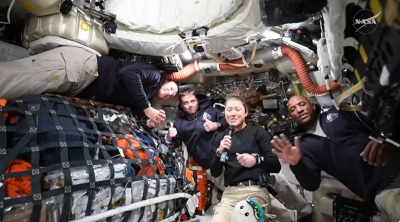
Jeremy Hansen, Reid Wiseman, Christina Koch, and Victor Glover have just performed a feat. The chances of dying in such an expedition are very high.
Yet, consider this. Their actions, at first glance, do not imply any immediate concrete result! There was not even a landing on the lunar surface to plant a symbolic flag, as Armstrong and Aldrin once did.
The results of this feat will not appear tomorrow. Nor the day after. Perhaps in ten or twenty years, others will follow them and begin to build something on the Moon. But even that is not yet a result, because the Moon is only an intermediate station. The true results of this work will be seen only by our distant descendants, when space travel truly becomes commonplace.
To the existing reality of the 7th Day, this is unusual. To the 8th Day, it is normal. They are paving the way, creating for others conditions for development over many generations.
Ancient Dream

Man has dreamed of reaching the sky since ancient times. One may recall the Tower of Babel or the myth of Icarus striving to approach the Sun.
Today the dream is beginning to come true — and is taking on new features. Outer space has turned out to be inconceivably, unimaginably vast — and at the same time utterly alien to humans. And our Earth is so beautiful — this becomes obvious when seen from space. Why, then, would humans need other, extremely inhospitable worlds? Yet we still strive for the sky.
To the existing reality of the 7th Day, this seems strange. To the 8th Day, it is normal. The mission of humanity in the Universe, as intended by the Creator, is greater than Earth. To feel who we are and why we are here, we have to go beyond the reaches of our home.
At the Limit of Capability
Most often, people are willing to invest effort and resources expecting to receive something in return. Not only in business. This is true for individuals and even more so for large communities and entire nations.
However, in space programs this is not entirely the case. The astronauts themselves, NASA, and everyone involved — directly or indirectly — are exerting maximum effort and investing enormous resources in work whose economic return looks highly questionable now. And not only now, but possibly for the next hundred years.
To the existing reality of the 7th Day, this is not rational. To the 8th Day, it is normal. We are participants in a project of the Creator on a cosmic scale, and it is He who gives us the resources and opportunities to go into space. This is absolutely necessary, because humanity has work ahead that goes beyond our planet.
Cooperation on the Scale of Humanity
People have long learned to cooperate, to negotiate, to do things together. But at some level, discord always began. Different nations have different interests, different religions oppose each other, and so on.
But space exploration is a task that makes sense only on the scale of all humanity and requires cooperation on that same scale. Moreover, this cooperation is based on new principles: what matters is not nationality, religion, or social background, but what a person can contribute professionally to the common cause.
To the existing reality of the 7th Day, this seems unrealistic. To the 8th Day, it is normal. Humanity will become a single whole in order to work in cooperation, dialogue, and partnership with God according to exactly these professional principles.
Planning for Millennia
We usually plan our actions — for a day, a week, a year. Rarely for five or ten years. Great thinkers, architects, writers, and scientists have looked centuries ahead, but in practice we rarely build plans spanning several generations.
Space programs today are just such a rare case. A flight to the Moon makes sense only as part of a larger project, including missions to other planets. Even now, the Artemis program is seen as an intermediate stage and a necessary foundation for expeditions to Mars. And expeditions to Mars — and eventually a permanent human presence there — require solving such complex problems that they cannot be achieved within a single generation. This work must be planned, and such attempts are actually being made. But the timescales here are centuries and even millennia.
To the existing reality of the 7th Day, this is reckless. To the 8th Day, it is normal. Humanity will be able to plan its work together with God within the framework of His design. These plans will take into account a much larger timescale than anything we have dealt with before, extending even to subsequent Days of Creation.
Thinking on a Cosmic Scale
Human beings have been developing their intellect since the emergence of our species. Over the past few thousand years, people have created fundamental science and developed complex religious and philosophical systems.
However, the true scale of the creation of God and the incredible complexity of the fundamental laws governing our Universe have begun to come to light only in the last century or two.
Once, humans built a boat and sailed the ocean. People did not become masters of the ocean, and some have never even seen it. But the beginning of seafaring dramatically and permanently expanded the horizons of all mankind.
Here we have a similar situation, but on a much greater scale. It is impossible to explore space while remaining within previous conceptions of reality and existing ethical systems. It is impossible to develop faith in God without taking into account the flow of information about His creations beyond our planet, which only increases with each passing year.
To the existing reality of the 7th Day, this is problematic. To the 8th Day, it is normal. Worldview, ethical principles, and scientific knowledge will develop under the guidance of the One God in accordance with the tasks He sets before us.
Mission
People have always reflected on the meaning of life. We are born, we live, and we die. Why? What comes next? Is there some higher calling for all humanity?
Different answers have been offered. Religions said that people must come to learn that God exists, learn to love Him, and repair the world according to His design, since we are like Him. Secular thinkers dreamed of a humane and intelligent society of the future. Eastern traditions taught self-perfection.
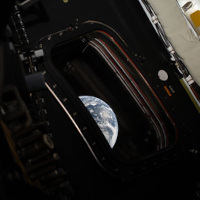
However, looking at Earth from a spacecraft window, one cannot help but ask about a larger purpose. There it is — our planet. Here is a human who has stepped across the threshold of their home. What comes next? Why did God create us? Why did God create the Earth? What is the role and calling of our planet and its inhabitants on the scale of the Galaxy, of the Universe?
The 7th Day does not provide answers to these questions. The 8th Day does. Humanity will discover its mission in the Universe — a mission of the Levites, for which God created us.
Transition
Humanity stepping into space may prove to be part of a much larger change: the transition of humanity into a new reality, which we call the 8th Day of Creation. What space exploration will be for the world, for humanity, and for God — depends on the meaning we put into it.
The Bible describes the Exodus of the Jews from Egypt, which can serve as a prototype of the transition to the 8th Day. They left the world they knew, crossed the sea on dry land, and came to Mount Sinai, where they entered into an alliance with the Creator. The day — or rather, the night — when they left Egypt has since been celebrated as the holiday of Passover. That is the Passover night.
The Orion spacecraft launched from Earth on Passover night of April 1–2, 2026. Perhaps this is not yet the beginning of the 8th Day. But it may become one of humanity’s first steps in that direction.
April 5–12, 2026
Information about the 8th Day of Creation can be found at www.day8.info
You can contact me by email: or Telegram: