AlgART / Articles and Books / Tikkun ha-Berit
Eli Talberg
Tikkun ha-Berit
View of the Torah on Sexual Development of a Man
Translation from Russian by Daniel Alievsky
Corrected by Lucas Orner
CONTENTS
- Part I. With a boy as an adult
- Part II. Happy husband
- Part III. Ish (איש) and Isha (אשה)
- Basis of Tikkun ha-Berit according to the sacred Jewish texts
- Why does it open today only
- The fairy tale of Rabbi Nachman from Braslav “The Lost Princess” with explanations
- From Yosef to Rabbi Nachman
- The Complex approach of Kind David
- The language of mysteries
- Three letters אמ"ש
- איש and אשה
- What King Solomon did not know
- What does it depend on?
- Is it possible to change the nature of my energy?
- Each intimacy gives birth to a soul
- Intimacy for conception and intimacy for strengthening the family
- Tikkun ha-Berit for married ones
- Advice for maintaining and strengthening the male power
- Applications
In the Jewish Kabbalistic literature “Tikkun ha-Berit”is the bringing of male sexuality to perfection. You may ask, "Do the Jewish sages devote the same attention to female sexuality?" Answer: to a much lesser degree. Why such “inequality?” As the sages say, it is due to the greater proximity of women to perfection. A man needs to work more on himself to restrain his sexual impulses." Maybe, for this reason, the Jewish covenant of circumcision applies to men only.
The modern human has an ability to look at the subject of sexuality through the prism of physiology, psychology, or teachings of the East. There are individual pieces of the Truth in each approach, but the advice of their representatives often contradict one another. Obviously an integrated complex approach is necessary to most effectively help a person to cope with their problems.
A complex approach is impossible without an understanding of God, because he is God, the Author of man's body, and his soul, and his morals. Especially in the Torah, teachings based on divine revelation are found showing a system in which all aspects of human life fit organically.
Developed on the basis of a complex approach based on the Torah, Tikkun ha-Berit includes, first of all, proper sex education for a teenager, as well as the harmonization of intimate relationships in family life.
Part I. With a boy as an adult
Introduction to the secular reader
We came into this world which exists under certain laws. We are trying to find our own way and to identify some regularities through trial and error. My grandfather, may the memory of him be blessed, said, “To find your own, you should give everything a try.” But even he believed that it is better not to adhere to this in some situations. In reality, there are things that can forever knock a man from his life's path. After for these things, he may pay with ruined health, or destroyed destiny, or even by losing his life.
As a rule, people felt shy talking about sex in Europe. Those who were not shy usually uttered various dirty and vulgar things. And those words were especially imprinted in the minds of listeners and agitated their imagination. And then they broke out into the same filth, vulgarity, and sometimes even criminal activity. And all this did not go unpunished. This was repeated again and again. Impure thoughts led to the same impure deeds, for which there was escalating retribution. Sons learned from their fathers, repeating their fate. A kind of “romance of the impure” was formed. In a famous Russian movie “Gentlemen of Fortune,” the character played by E. Leonov says: “I stole. I got drunk. I was thrown in prison. I stole. I got drunk. I was thrown in prison. The romance.”
The present day can be characterized by two phenomena: 1) the removal of the taboo of discussing sex and sexuality, 2) the clear appearance of the new generation yearning for perfection. The modern man has gained the ability to look at this subject through the prisms of science, psychology, and Eastern teachings. Some elements of Truth exist in each of the approaches. Science describes the human interest in sex with help of hormones, psychology — with help of instincts and psychological complexes, the teachings of the East — with help of male and female energies. All these approaches operate with concrete facts, ignoring such concepts as “morality” (especially violations of moral laws, which can ruin a person's future and in most cases take lives) or ”love” (not everyone is satisfied by an explanation that it was ”an increased ejection of sexual hormones into the blood streams,” or “a basic instinct,” or “an exchange of energy”). This indicates the absence of a complex approach within these systems. In addition, the recommendations of scientists, psychologists, and the gurus of eastern practices can essentially differ, for example, on teenage masturbation or retention of semen.
A complex approach is impossible without the concept of God, because only God is simultaneously the author of the human body, of the soul and of morality. And if all these things come from the single Source, then at the level of pure information (“pure” in the sense of “cleaned” from subjective human impurities) they must not contradict each other, but should be packed into a single system. The Torah is such a system. Its teachings are the direct transfer of information from God to man. The Torah is the only worldview system, which, on the one hand, speaks about the loftiest sentiments and recurrent sex between husband and wife, and on the other hand, about the necessity of the strict control over their sexual desire.
To come to a more detailed study of the approach of the Torah, we must separate it from the approaches of the two religions that grew out from it. Let's start with Christianity. Christianity followed the way of limiting human sexual experience in order to achieve spiritual growth. Sexual desire was considered sinful, which greatly contributed by the concept of Original Sin. Islam went another way by permitting a man to take multiple wives and any free woman on the side, so that there is no continence required from men by the Quran.
Now let's talk about the approach of the Torah. Already in the second chapter the Torah tells how God has created a single man and from him made a man and a woman, and further states, “Therefore shall a man leave his father and his mother, and shall cleave unto his wife: and they shall be one flesh” (the word-for-word translation of the last sentence: “...and they become to one flesh”). Thinking about the meaning of this story, it becomes obvious that the issue here is the unity of a man's and a woman's emotions and energies, available only to humans. Please note that it does not just say “one flesh,” but “to one flesh,” which emphasizes desire, yearning, and movement, and not a static physical unity of two bodies. This description of the Creation of Man differs from the story of the first chapter of the Torah, which states that the Almighty has created man as a biological species like all the other creatures of the earth, namely as a male and a female (in Hebrew “Zakhar” and “Nekeva”). Every person decides for himself what kind of relationship he builds with the opposite sex: a loving relationship between men and women or a relationship based on carnal desires.
Both the Written Torah and the Oral Torah give a lot of examples singing the love between a man and a woman. And the Torah raises prohibited sexual relationships to the category of the most serious sins before God and before men.
Also we can say that the Torah, on the one hand, is well known to people with a European mentality, and on the other hand, the secrets of the Torah, like the Kabbalah, only recently been revealed on a small scale to a wide range of people.
How to become an adult?
What makes a man an adult? Is it really just age? The sages of the Talmud discuss this issue, focusing on the Tree of the Knowledge of Good and Evil. As it is written, when Adam and Eve had eaten the fruit of this tree, “their eyes were opened,” meaning that their “adult life» had started. A question is raised in “Midrash Rabba”1: what was this tree (the text of the Torah does not specify which species of tree) or, in other words, the knowledge of what makes a person an adult? The sages give four answers.
Answer I. The Tree of Knowledge is wheat. It absolutely does not matter that the wheat is not a tree. This response is figurative. Its sense being that a child becomes an adult when he himself can earn his bread. The first time a child earns money on his own, it gives him some freedom from his parents, especially if it is earned through hard work. The sages compared this with the fact, that a dove, released by Noah after the Flood, returned with an olive branch in its beak. But olives are bitter? Yes, and it was like the dove was telling Noah that bitter bread, like the leaf of an olive tree, is better than something sweet, like honey, but from the hand of someone else.
Answer II. The Tree of Knowledge is a grape. Grapes are a symbol of wine, and wine is a symbol of pleasure. Wine, cigarettes, and drugs are all “pleasures enjoyed by adults” in the eyes of children. So, they try them. They try “to be like adults.” These words evoke irony in an adult man, but please remember your own childhood! And really, when a man experiences new feelings, he changes. Does he become an adult? Maybe. I personally want to add that having fun is a science that needs to be learnt and taught. Parents help their child learn from birth to sit, stand, speak, etc. Why don't they teach them how to have fun? For example, a child can learn to speak on the street, but at home his parents correct him, teaching him what and when to say certain things, and what is better not to say at all. In addition, a child learns to say his first words at home anyway. I think that the same should be done with learning about pleasure.
Answer III. So, we draw nearer to the subject of this book. The Tree of Knowledge is a fig. You remember that Adam and Eve covered themselves with fig leaves after eating the forbidden fruit. By the way, do you remember, what exactly they covered up with those leaves? Right, not the head (protecting it from baking in the sun). Thus, the relationship between sex and the Tree of Knowledge of Good and Evil is set. It can be sensibly said that, sexual experience makes a person an adult. This is especially true for girls. Not wanting to hurt anyone's feelings, I'll say that when a girl becomes pregnant, then she has become adult.
Digressing from the subject for a bit, I want to note that we are discussing the Midrash, which is a figurative model that cannot be understood literally. It does not come out of the Midrash that it is possible to equate the Tree of Knowledge and sex. It is precisely that mistake which the early Christians committed when declaring that sex was the “Original Sin” of humanity, the sin, which (unfortunately for the church fathers) accompanies humanity throughout history.
Answer IV. The Tree of Knowledge is a etrog. The etrog is a citrus tree, from which the wood and fruit are equally edible. The fruit symbolize the goal, the wood — a tool. If I understand the words of the sages correctly, the idea sounds like this. One of signs of maturation is the ability, not only to specify one's dream, but also to offer a realistic plan for its implementation. Really, even in kindergarten a child can say, “I want to become an astronaut,” but much later in life they begin to train and learn how to make that dream a reality.
It is important to note that there is not a dispute amongst the four positions, but rather four perspectives on the one phenomenon. I emphasize the word “one.” The process of maturation involves all four components.
And then everything depends on the individual: one person matures at 13 years, another at 30, and yet others do not mature at all.
Hormones and fantasy
Most boys start puberty between 12–14 years of age and end when they are 18–20 years old. As a result of this process, the genitals more intensively produce sperm and male hormones, which leads to a change in the whole chemistry of the body. Sex hormones stimulate the work of hypophysis, and that, in turn, increases the activity of other endocrine glands. The whole body begins to develop more intensively. A good example of this is the muscle mass. The muscle mass of teenagers increases by 12% in two or three years, which is much higher than the rate of muscle growth in previous years.
Changes during puberty affect not only the physiology, but also the psyche of a teenager. Recent scientific studies have shown that sex hormones affect the cell structure of the brain. Hormones also begin to affect the thought process. A boy catches scenes from movies, pictures from magazines, the sayings of “experienced” men — all of which contain intimate details of communicating with women. This information is not simply accumulated, it becomes food for fantasy, for the imaginary erotic scenes in which a boy plays the main male role himself. These fantasies become more and more frequent. By the way, young men, who play sports or participates in different study groups, are less focused on the subject of sex because they have less idle energy and free time.
Imagination requires more and more new food, so the activity level of the eyes continues to rise as it searches for something new. A youth's eyes eagerly catch the contours of a female figure, even if this woman is merely walking down the street or sitting near him on the bus. When describing this look people say, “He is undressing her with his eyes.” There are even a number of anecdotes on this subject. For example, a girl walks up to such a youth and says, “And now please put my cloths back on the the way they were” or, “After what just happened between us, you're obliged to marry me now. ”
Often at this age, especially for those who are easily aroused, involuntary norturnal ejaculation happens. “Nocturnal” because it happens during a night's sleep, and ”involuntary” because, in the opinion of many, a man does not control himself while sleeping. When in fact, ejaculation does not occur without the presence of heightened nerve activity. The whole process looks like this: sex hormones reach the brain in the bloodstream, where they seemingly place an order for dreams with sexual content, the arousal grows, and at some point the brain gives the command to “open the valve.”
Is this good or bad? There are varying opinions on the subject. One of them can be reduced to the following anecdote:
Doctor: “Tell me, do you worry about erotic dreams?”
Patient: “Well, but why ‘worry’?”
Many agree with the modern medical school, not considering the night involuntary ejaculation a pathology. Jewish Law strongly condemns the unavailing ejaculation, even if it occurs unexpectedly, and holds the man responsible for insufficient control over himself. In “Kitzur Shulchan Aruch” a whole chapter (Ch. 151) is devoted to preventing unnecessary ejaculation and how to compensate for its consequences. Here's how it is substantiated. “The sperm is the energy of the body and the light of the eyes. When too much is ejected, the body is destroyed and his life is lost” (Ch. 150:17). The chapter ends with the following words, “The wisest of the doctors said, Only one out of a thousand people die from disease, and a thousand from too much sex. Therefore a person should be careful.”
Note the phrase “the power of the body.” Despite the fact that modern medicine does not use this concept, it's clear to all that, for example, the body loses its vitality with the loss of blood. Intravenous infusion of another liquid never compensates one hundred percent for blood loss. And the reason here is not a chemical composition, but namely the vital energy. (The words “vitality” and “vital energy” are often used as synonyms. To satisfy a more captious reader I'll say: the thing, which is popularly called “the energy of the human body,” better fits the description of the physical concept of a “force field.” For simplicity sake, the term “energy” will be used here.)
The sages of the East believed that one drop of semen is equivalent, by the vital energy, to a hundred drops of blood. I, unfortunately, have no instrument to measure the amount of energy in different liquids, but please think over the fact that one portion of sperm — a few milliliters! — contains about 200 million spermatozoa. Each of them is charged with a reserve of energy, enough to be able to reach an ovum inside the female body, to impregnate it and to initiate the life of another human. Imagine the path of a spermatozoon and mentally multiply it by 200 million! It is a colossal energy, and it is within the body of a man. The organism spends this energy during each ejaculation, and spends it for nothing if there is no intent to conceive a child. Moreover, after each emission of sperm the body automatically produces a new portion. Production begins with the intensive collection of vitamins, minerals, trace elements, hormones, proteins, enzymes and other vital matters, and, most importantly, energy from the entire body. And it is precisely those things which are so necessary for a growing organism.
Er, Onan and onanism
Erotica and onanism. Where did these concepts originate? Many believe that the word “erotica” is linked with the name of the Greek god of love, Eros, and onanism is named after the biblical Onan. I think that the version, according to which both words have their roots in the Bible, is more probable. Really, if you think about it, erotica has not become synonymous with love, but the story of Er gives us the key to a deep understanding of this word.
Let's try to understand the words of the Torah. “And Judah took a wife for Er his firstborn, whose name was Tamar. And Er, Judah's firstborn, was wicked in the sight of the LORD; and the LORD slew him. And Judah said unto Onan, ‘Go in unto thy brother's wife, and marry her, and raise up seed to thy brother’. And Onan knew that the seed should not be his; and it came to pass, when he went in unto his brother's wife, that he spilled it on the ground, lest that he should give seed to his brother. And the thing which he did displeased the LORD: wherefore he slew him also.” (Genesis 38:6–10).
From the text it is clear that Onan spilled his seed in vain. But what was wrong with Er's behaviour? Rashi gives the comment, according to which in the sentence “...He slew him also” the word “also” means: for the same reason, that Er was slain, Onan was also slain. So, Er spilled his seed on the ground too. Then what's the difference between erotica and onanism? In the inducements. It's said of Onan that his goal was to avoid impregnating Tamar, and if he could, to completely avoid relations with her. Likewise “the descendants of Onan” try to have fewer relations with the living women (saving time, money, nerves) and, therefore, solve their physiological problems “by hand.” Er also did not want Tamar to become pregnant, but his motives were different. He didn't want Tamar to conceive and, as a result, for her beauty to fade (treatise Yevamos 34b). In other words, for Er the aesthetic pleasure of a woman was in the foreground. That is, he loved to watch! It is clear, that when a man watches, and a woman slightly exposes her body, a man's fantasy brings him to such an arousal, that it will not end by itself. As a result, seed will be spilled in vain again. Those who claim that their goal is aesthetic pleasure only are deceiving themselves. This is similar to how a person looks at the process of cooking food, inflaming his appetite, and at the same time claiming that he is not going to eat.
The habit of erotic fantasies and sensation, having become habitual to an onanist, will necessarily lead to difficulties while constructing a harmonious relationship with a real-life companion. But the main problem here is just the waste of semen in vain. It is interesting to watch how not only Jewish but also Taoist sources (which have become available to European and American non-Jewish readers before the Jewish religious texts, despite the fact that Jews have always lived in the neighborhood) do not only say the same thing, but almost in the same words. Judge for yourselves.
“With the frequent ejaculation of sperm, vitality ultimately plummets. The big spender loses stamina, his vision begins to weaken, hair tumbles from his skull, and he grows old before his time. At first he will not feel drained, but after years of abuse his capacities will begin to drop alarmingly. When the hormonal secretions of the sexual glands are regularly leached out, the body is sapped at its roots” (Mantak Chia, “Taoist Secrets of Love”).
And Jewish text says, “The sperm is the energy of the body and the light of the eyes. When too much is ejected, the body is destroyed and his life is lost. Any one who is addicted to having sex, old age comes upon him. His power fades, his eyes darken, and a bad smell comes from his mouth. The hair on his head and his eyebrows, and his eyelashes drop out... Many other troubles apart from these come upon him” (“Kitzur Shulchan Aruch,” 150:17).
The source of true knowledge is one — all knowledges come from God. But the ways of obtaining such knowledges are different. Jewish wisdom is based on divine revelation, while Eastern wisdom — on studying the world, created by God. Here is another parallel. Mantak Chia uses the word “spender,” and the author of “Kitzur Shulchan Aruch” writes that the man, who spills out the seed in vain, grows poorer (151:1). This, at first glance, contradicts the thoughts of the onanist, because it seems to him that he saves on women. While saving money, he is not saving his seed at all. What's next? The attitude toward his body gradually begins to be projected onto other areas of his life, including in relation to money. There is a growing subconscious desire to spend money, and the saving mode, sooner or later, starts to fail. If a man thinks, “There is no reasons to regret spilling seed: I have plenty,” then as a result he loses both health and money.
What does it mean to “be a man?”
A man is not one who possesses high levels of male hormones, but one who knows how to control them. Not possessing the ability to control oneself is called being a “male,” as well as specimens of same sex in other species of living beings. Men are not born, males are born. It is possible to become a man only as a result of self-education and working on oneself. There are some people who live all their life as a male, never becoming a man. In this chapter we shall learn to work on ourselves.
The offered approach is multilevel. It will help youth to cope with certain problems, which, unfortunately, do not let go of many even after the wedding. For this reason, our advices will be helpful to married people also.
Examples of the practical benefits of the controlling ejaculation:
- Saving life power that allows proper physical, mental and intellectual development.
- Preserving health for every year of life given by God.
- A way to protect yourself from the temptation to commit a sex crime or from lechery.
- A way to prepare yourself for the perfect relationship with your wife. The ability of a man to control himself will help women enjoy intimacy with him.
Generic prevention of unnecessary2 ejaculation
1. Working with the thoughts. (It's clear that anyone can pick up on logical arguments closest to him. I give only an approximate line of thought.) Each portion of the seed coming out is a colossal loss of vital substances and trace elements, and most importantly is a huge loss of energy. A man who turns off the lights when going to sleep saves electric energy. Why? Because he pays for it! A man who spends a seed in vain forgets that he had to earn money to buy and cook food for the production of this seed. And then the whole body is involved in digesting the food, assimilating it, the blood carries the distributes elements to all the cells of the organism, the cells produce energy. The energy, which goes to the production of seed. How a man, who saves electric energy, squander the vital energy of his own body, which cost him much more? Does the repeated loss of energy, which leads to early aging of the organism and to an early death? The sages of Israel carefully guarded their seed, and it is not by chance that they lived long and enjoyed good health and bright intellect for many years.
2. Working with the fantasies. As mentioned above, after puberty sex hormones begin to flow into the blood. They are spread throughout the body by the bloodstream and, in particular, reach the brain. The brain begins to produce sexual fantasies under the influence of sex hormones. But fantasies need a “living material,” and the eyes look for it in the surrounding area. Further, these fantasies push people to implement action (which is, in most cases, either lechery or crimes of a sexual nature), or to ejaculate in vain for temporary (just temporary!) quieting of these fantasies. The Torah warns about this in the commandment about tzitzit, saying, “...and that ye seek not after your own heart and your own eyes, after which ye use to go a whoring.” First the Torah says “heart.” What is in the heart? Desires and fantasies. And then the Torah says “eyes.” In other words, the searching for an object in the outside world that can satisfy these dreams. The control of the imagination is also addressed in the tenth commandment sounded at the foot of Sinai, “Thou shalt not covet thy neighbour's wife.” This means that it is forbidden to imagine yourself in the arms of another man's wife.
There are two basic ways to work with your own imagination: the switching on the mind and the directed continuation of imaginary play.
I'll give some examples of switching on the mind. Here's an example from the Torah. “And it (the blue thread) shall be unto you for a fringe (tzitzit), that ye may look upon it, and remember all the commandments of the LORD, and do them; and that ye seek not after your own heart and your own eyes, after which ye use to go a whoring.” Here's how it works. Tzitzits must be at the four edges of the man's clothes as a symbol of the four cardinal points. Wherever a man looks, a tzitzit must catch his eye so that it will divert his thoughts towards God's commandments and will distract him from empty dreams. Another method of switching suggested by the Jewish sages is upon seeing a beautiful woman, to bless God who created her. Pronouncing sentence beginning with the words, “Blessed are You, God...” as it turns on a man's awareness of the Creator's presence. And it leads to the next logical analysis. “There is God, and He forbids one thing, but allows another. In terms of the total Correction of the World, if what I've now imagined up will come to realization, is it good or bad?” Another method of switching is described in the book “Torat ha-Sehel.” We must ask ourselves, “And what is beautiful in her? What exactly about her excited me? And what is true beauty?” The essence of this technique is simple. When you start to “disassemble something to its basic parts,” the fragrance of charm goes away.
The second way of working with the imagination is a directed continuation of the fantasy. Erotic dreams usually end in an imaginary sex act in which “he gets all he wanted.” In real life, the sustained efforts of both spouses are necessary to achieve harmony in the sexual sphere. No one invests the soul into a casual relationships, and therefore the full satisfaction will not be received in any case. Now you need only to replace “a perfect act” in your imagination with a picture of the coming dissatisfaction. Moreover, in these fantasies the sex act ends everything, but in the real world it is not so. Real people remain with whom the continuing communications was not included in the plans. New problems are appearing. Note that most rapists were not planning to kill their future victims, but rather they did it out of fear of punishment for the already-committed rape... Thus, while controlling your imagination, you can imagine that you not only received less pleasure, but also that dealing with danger will present a problem.
Working on controlling the imagination is very difficult for anyone, but it is the most important, and its results are felt very quickly. Chasidism teaches that one who wins every battle with his imagination, and therefore does not commit hasty acts, is worthy to be called a good man, but one who managed to win the whole war is called righteous.
3. Working with the energy of the body. During sexual arousal, a large amount of energy is accumulated at the underbelly and is longing to get out through the penis. At this moment it is best (closing the eyes for convenience) to imagine the underbelly as the bottom of a waterproof vessel and begin to pull the energy from the bottom of this vessel through the waist and up the back up to the head. At first, the sensation of pulling energy up seem more imaginary than real. But after some time (note that one rarely obtains it on the first try) the man will feel strong pressure in the skull. Feeling the pressure means that the energy has reached the head. This sensation is unpleasant (head seems to be brimmed), and staying in this state long is dangerous, especially for people with high fragility of blood vessels. The energy should be immediately “dumped” from the head downward along the front line. Two central stations and two intermediate ones can be marked out on this way of the energy. The central ones are the heart and the underbelly in front. The intermediate ones are the throat and the navel. The central stations differ from the intermediate ones by an ability to hold more energy and to derive it from the body. Directing the energy downward, you can help yourself by using your hands, firstly, like as if brushing it onto the ground. You should not be afraid if the discomfort in the head has not ceased immediately because it will take a few minutes. Then a peculiar feeling in area of the solar plexus will appear. Like the light from the sun, the energy will flow from it in all directions, and there will be feeling of inner power. After this, the energy can be sent down to the small pelvic area. And once again the feeling at the underbelly will be similar to feeling of sexual drive, but not as strong as is was at first. If you drive the energy up and down again, the feeling will become even weaker, and the whole body will get energy supplied. For young men whose wedding is not soon, I recommend lowering the energy down and driving it around in a circle: upwards along the back line, downwards along the front line. It is good not only for the growing organism and developing personality, but also for the future harmony with one's wife, because she will be involved in this circle of movement of the energy (we'll talk about this below in detail). For young men preparing for marriage, it is better to accumulate energy in area of the heart, because the man “glues” to his wife just by the heart (this will be below also).
4. Physical exercises. At the time of puberty, the muscle tone of the reproductive system of a youth is the highest in his lifetime without any extra efforts on his part. But it will not be so for long. Soon enough, the muscles will begin to weaken, their strength leaving. The suggested exercises are very simple. Their value is not perceivable at a young age, but its awareness comes while growing older and aging. These exercises will help you:
a) learning how to manage the individual muscles that will be useful for one's future sex life;
b) preserves a man's strength for a long time.
Exercise 1. Do not urinate in a sitting position, even during the excretion of feces. This exercise will help to give focused control of the urethral sphincter.
Exercise 2. In the standing or lying position, move your buttocks apart with your hands. Return the buttocks to the starting position by squeezing the buttocks together, while creating resistance with your hands (10–20 times).
Exercise 3. “Scissors.” Lie on your back. Lift your legs, without bending the knees, at a 30–45° angle from the ground. Spread your legs as far as you can to the sides, and then bring them back and cross them in the air (15–20 times). Exercises 2 and 3 help to strengthen the pelvic floor muscles.
Exercise 4. Standing position, feet shoulder width apart. While inhaling, pull the testicles upwards as far as possible. While exhaling, relax the muscles. Do not perform this exercise more than 5 times. This exercise strengthens the Pubococcygeus muscle and is helps prevent inguinal hernias. In addition, a hanging scrotum is a sign of senility and sexual weakness, but a strong one tucked up to the body is a sign of youth and male power.
These exercises are good for men of any age, but the sooner they start practicing, the greater the effect that can be expected.
Prevention of nocturnal involuntary ejaculation
- Do not eat a lot before going to sleep and do not eat fatty foods.
- Lying in bed, think of something good not associated with sex.
- Falling asleep, task yourself with stopping erotic dreams.
- If you cannot stop an erotic scene of a dream and the urge of an erection have begun already, you need to quickly stand up on the floor, clench the muscles of the pelvic floor and thighs, and intensely pull the energy through the backbone to the head until the urges completely cease.
- If you cannot relax and stop the erection, you should apply pressure with your fingers. Strongly press your fingers at the point midway between the scrotum and the anus. This is the place where the spermaduct connects to the urethra, which when pressed prevents semen from getting out. Let's suppose that the finger pressure has prevented an ejaculation, but a part of the energy has still gone out, and the remaining part is “seething” at the underbelly. Then you need to pull the energy up to the head again.
The above technique is extremely useful. You just need to begin working on yourself.
About love
Judaism is a religion of joy.
R. Hirsch
Love is one of the major (if not the major) aspects of the life of any person. Whoever says that he does not need love is simply a hypocrite. The opposite extreme is the view that true love can be given to God only, and that the love between a man and a woman is, at best, a parody, a surrogate of true love, and is needless in general. Our inner sense of protest often alienates us not only from people who say this, but also from the religion as a whole because we usually consider these people as the bearers of God's truth.
Certainly, love for God takes center stage in the Jewish worldview. Not in any way wishing to belittle the significance of this love, let's try to understand the place of the love between a man and a woman in Judaism.
So, at the very beginning, the Torah says that God created Man. On this subject the Oral Torah says that he was the most perfect person, and that his soul contained the souls of all humanity descended from him. Let's imagine for a moment the greatness and perfection of the First Man, who lived in love and harmony with his Creator and all of His other creatures. Despite all of this, it is written in the Torah, “...And the LORD God said, It is not good that the man should be alone.” “How so?,” we'll object. “God is with the Man, loving him and beloved by him. Is that not enough?” But the fact of the matter is that these words are said not by the man, but by God! That is, God himself says that a man, in addition to the love of LORD, also needs the love of a woman, and a woman — the love of a man.
Another fact, confirming the high value of love between a man and woman in Judaism, is “Song of Songs,” written by King Solomon. The Jewish sages say that King Solomon sings the love between God and his nation in the “Song of Songs,” clothing it in a form of the feelings of a man to his beloved. King Solomon uses this analogy not by chance. Namely that the love between a man and a woman was an example, closest in its inner essence and purity, to describe the love between God and a person. If someone does not have enough intelligence to understand this truth, he can rely on King Solomon who is considered to be the wisest person to live on all the earth.
Jewish tradition distinguishes between two kinds of love: passionate and growing. The passionate one begins immediately from the highest heat of emotions and continues on the same level. The growing one takes a low start and gradually grows. Both types of love are found in the life history of the forefather Yaakov. The love of Yaakov and Rachel is love at first sight until the last breath. Such a feeling does not depend on appearance, or on the character of the object of love, and even the inability to procreate cannot damage it (Rachel was not been able to get pregnant for a long time). The love of Yaakov and Leah is a partnership, which becomes stronger depending on the good that the couple does for each other. Only the absence of antipathy towards the partner is required to start such a relationship, (even sympathy is not needed), and also the desire to do him good. A kind of love shown by Yaakov and Leah grows gradually, becoming stronger with the appearance of shared children and the growth of efforts invested in one another. Attitudes towards children is also revealing. Yaakov loves Yosef and Ben-Yamin, because Rachel presented them to him, and loves Leia for those children that she had presented to him. In spite of the fact that the passionate love looks much more attractive, the Torah shows us that its short life. It is either interrupted with death (as in a case of the foremother Rachel), or is eventually transformed into a love of the second kind. Note also, that it is the foremother Leah who is buried in Machpelah cave in Hebron together with the forefather Yaakov.
The two kinds of love can be figuratively compared with two kinds of glue: slow-setting and instant-setting. The result is same, but there are differences. When using a slow-setting glue, a man has enough time to accurately position the items to be glued, while instant-setting glue leaves no room for error. It's interesting that the Torah also uses this comparison. “Therefore shall a man leave his father and his mother, and shall cleave (lit.: ‘glue himself’) unto his wife: and they shall be one flesh” (Genesis 2:24). The word “dvekut” (the name of the process, formed from the root “devek:” “glue”) is used in the Jewish tradition both to describe the highest form of approachment of a man with God and to describe the relationship between husband and wife.
While discussing this subject it's impossible not to recall the commandment of the Torah, “...but thou shalt love thy neighbour as thyself.” The famous Jewish sage of I–II cent., Rabbi Akiva said, “It is a great principle of the Torah,” and, “Achieving this level is possible only in the relationship [of the husband] with the wife.” As I understand, Rabbi Akiva keeps in mind that the Torah requires us to build a relationship with God and all his creatures, especially with one's spouse on the basis of love. Another wise man, Ben Azay, also made an interesting comment about this commandment saying, “It is the history (lit.: ‘genealogy’) of humanity.” Consider just how great of an idea that is! Any history textbook is full of descriptions of wars, revolutions, epidemics, earthquakes— in short, tragedies. We are accustomed to thinking of history in that way. Ben Azay offers a qualitatively different view: that the history of humanity is the history of love. More precisely, the history during which mankind learns to love. This is similar to the growth and maturation of a child. First, he thinks about himself only (how to satisfy his needs and get things from others), but as he grows older he starts to think about other people, about their needs and feelings. A person learns to give. A person learns to love. Kabbalah says that the [spiritual] root of the term “love” is in the sefira of Chesed (the desire to do good to another). In the same way, humanity as a whole gradually learns to love until they reach a general harmony. And here, again referring to the words of Rabbi Akiva, we'll say that we must begin with the family.
Of course, both love and hatred occur in life. It depends only on the person, to what he gives attention to and what he wants to learn.
Part II. Happy husband
The delight: luxury or necessity?
People treat delight differently. There are three main approaches:
- Delight is a benefit, which should be achieved.
- Delight is an evil, from which should be abstained.
- The approach of the Torah.
Let's consider all three approaches in more detail.
I. Man is so made that he unconsciously has a longing for delights. A child, having tasted sweets for the first time in his life, begins to demand it again and again. Having grown older, he learns of more delights and longs for them, and upon receiving one, immediately begins to strive for the next. As a result, life is transformed into a continuous pursuit of delights. Here is a quotation from Omar Khayyam3, glorifying this lifestyle:
I will enjoy, for as long as I live,
the tender face of a woman and the green grass.
I drank wine, I drink wine and, probably,
I will drink wine to my last minute.4
And here's another:
In this life, inebriation is best,
a tender houri's song is best,
ebullience of free thought is best,
forgetfulness of all prohibitions is best.4
Here the author mentions some “prohibitions.” It turns out that the continuous receiving of delights contradicts social norms. In addition there are also natural difficulties. There is no money. There is a lack of desire from the people on whom the delight depends, etc. What should be done in this situation? Go commit a crime or go to work? In any case, you have to pay for the delights, either before or after. There is an option to take no action, to just sit back and hope that one day the delight will come by itself. Many people live this way all of their life. Most of them die with a feeling that they have not seen the delights of life at all. A small percentage of these people are driven to criminal activity due to a sense of lack of delights. It's a vicious circle. “Pleasure is a boon, when it does not cause repentance” (Antisthenes). And here is another of his sayings. “One ought to seek pleasures that follow toils, not precede them.” This approach seems most prudent. It does not prejudice the interests of others, as in a case of a crime, and at the same time active steps are taken, unlike the passive waiting. But let's look more closely. The phrase “should aspire delights” means that the acquisition of delights is the goal of life. What would the life of a man with such a worldview look like? Either he will be lucky, and his works will lead to the realization of his dream (but then what will he aspire to later?), or he will grow old with the feeling that he was lacking delights in his life, or he will commit a crime. The circle is closed again.
Awareness of all this pushed some people to choose the second approach. Here is a saying of Socrates. “What person, when he is a slave to pleasures, would not pervert his body and soul?”
II. Delight is evil. “Nature did not give anything more dangerous and perilous to people than sensual pleasures. They cause betrayal of one's homeland, overthrow of state authority, secret dealings with enemies. There isn't a single crime, a single bad deed, in which the passion for pleasure would not involve one: indeed, dishonest acts, adultery and suchlike abominations are caused by nothing else but the bait of pleasure” (Archytas). And Aristotle comes to the following conclusion. “More than anything else, one should eschew pleasure and whatever brings it.” A person with such an approach to life is much more resistant to committing a crime. But does this path lead to happiness? Such a person does not listen to the needs of his body and soul but tries to suppress them by the mind. He is deprived of delights, trying to convince himself that does not feel needs for them. His goes through life in a continuous struggle with himself. It is not easy to live near such a person, because he not only refuses himself delight, but also tries to impose on those around him his opinion of their immorality. Such a person cannot be happy for two reasons:
1) its purpose is not positive;
2) happiness is itself a state of the soul, not an intellectual aim.
In the form of jokes I'll give another Omar Khayyam's quatrain:
I asked the wisest of men: “What did you get
from your manuscripts?” The wisest man replied:
“Happy is he who is far from bookish wisdom
at night, in the arms of a tender beauty.”4
Well, now seriously, is it possible that God has created delight (God has created everything, so, delight too) with the only purpose being to prohibit a person from receiving it? The answer is no. It can be seen in the Torah commandment about Nazir (a person who voluntarily accepted additional restrictions in order to increase his level of spirituality). After a period of separation, he had to bring two sacrifices to God in the Temple: the burnt offering and the sacrifice for sin. What kind of sin is in question, if the man was trying to get closer to God? The Talmud answers that the sin in this case is receiving less delight.
So, deliberate objection to enjoying delights is also not ideal in both the people's eyes (the majority of humanity) and in the eyes of God (of course, this is a figurative expression, not literal).
III. The approach of the Torah is that delight is a necessary concomitant factor on the way to the goal. I would like to emphasize that, on the one hand, it is necessary and, on the other, only a “concomitant... on the way to the goal” not an end in itself. The goal must always be higher and greater than just having delight. This is a qualitative difference from Approach I. For clarity, let's consider this for sexual delight. It's not a secret to anyone that it is not necessary to create a family in order to receive delight of this kind. Really, who needs a family, if sexual delight is an end in itself? As some joke, “The family costs more.” In this approach to life, the delight itself can become the simple satisfaction of physiological needs. The Torah sets the highest goal before a person: achieving perfection. And you cannot do it alone. At the beginning the Torah says that God created a person, and then divided him into a man and a woman. From this we can conclude that the “person” as a functional unit of the universe is just a couple, not an individual man and woman. Only Dvekut of man and women makes it possible for further progress on the way to perfection. It is clear that Dvekut includes a lot of factors such as emotions, energy, economic community, the desire to have children together, etc. This whole set is simply irrelevant in relationships without the intention of creating a family, as well as in relationships outside the family. Now, let's discuss intimacy. Harmony in this sphere is one of the most important factors of closeness between a husband and wife. The shared delight from sex strengthens the family. The feeling of unity obtained through it is reflected in other areas of family life and contributes to achieving family happiness. Thus, a happy family is a goal, and sexual delight is a necessary concomitant factor. With this approach, sexual delight itself is filled with much higher sense than the simple satisfaction of physiological needs. Voltaire commented on this and not only on this. “The true delights are impossible without true needs.” And these are the words of Rabbi Yehuda Halevi, spoken long before Voltaire. “Whoever is unable to pursue such a course, consider not his pleasure a human pleasure, but a brutish one” (Kuzari, 3:17).
Using the same example, we'll show advantages of the approach of the Torah on delight compared with the approach that “delight is evil.” If an uncontrollable desire for sex leads someone to lechery, it's not necessary to conclude from this that the desire for the wife is evil too. Such an attitude will inevitably lead to an increasing distance between spouses. Despite the fact that such a family can look “very decent” outwardly, there is no a question about any Dvekute. The Jewish approach offers such a person, that rather than spend his life in the struggle with his animality, to use it (it's clear, with carefully monitoring) in the way of service to God. A happy family is a necessary foundation for a person's spiritual growth. The forefathers (the founders) of the Jewish nation give us examples confirming this rule: King David (the founder of the house from which the Saviour of all humanity will be descended), Rabbi Akiva (whose disciples brought us the largest part of the Oral Torah, which connects us with the Sinai Revelation), and many other great people who achieved their spiritual heights, being happy in marriage.
This conversation can be continued further, but I think it's a time to turn to the most frequently encountered problems on the road to family happiness and finding ways to solve them.
“What could he need?”
Do you remember the saying: “It takes two to tango?” I think you know that the tango is a pair dance. This phrase has become proverbial by the word “two.” A successful dance needs the efforts of both partners. Now let's replace the word “tango” with the word “family.” This and the following chapters are addressed to the wives, because sharing happiness depends largely on their family wisdom.
The very title of the chapter hints that here we will discuss men's marital infidelities. In this situation, public opinion traditionally condemns the cheating husband and gives pity to the wife as an “innocent victim.” I'm not going to justify the husband, but if “it takes two to family,” then we must consider the role of the wife in such a story. I am sure that most of men's infidelities can be prevented by intelligent actions of the wife. To begin with, I would like to remember the saying of Pythagoras. “Prudent wife! If you want your husband to spend time with you, take care that he should not find such pleasurable sensations and tenderness in any other place.” There is no need to be Pythagoras to understand the simple truth that the wife should attend to her husband. So, the attention of the wife (at least a part of it) should be aimed directly at her husband. Led down the wrong path, many women incorrectly think, “Really does he not understand that I'm busy with the home and children? And really don't I do it for him?” Certainly all this is very important. Every effort spent on the family is extremely valuable, but do not forget where all this began. The time when there was no home, no children yet, and all the attention was directed entirely at one another. It was a time of romance. A time when both were trying to please each other. The girl was trying to look beautiful in the eyes of her fiancé... Years passed. Now there is a family “just like everyone else.” Continual troubles. The wife only “makes herself up” when going to work or “going out.” At home she can relax, be herself, thinking, “My husband already knows me!” Thinking of romance “is somewhat not serious.” And in such a “problem-free” family a clash of thunder “out of the blue” appears. But wasn't the sky clear and blue? Of course, there will be woman readers who will say, “What do you want? Life has changed. These days a woman studies and works and does not just sit at home. Husbands must accept this!” Ok, husbands will accept this. But then wives also should not be surprised if their husband “goes off the rails.” And if it happens, do not pretend to be an innocent victim and engage in self-pity like, “So, he didn't love me.” or, “So, he became a frivolous man.” or, “Well then, no luck.” Perhaps it sounds a bit cruel, but our goal is not to accuse or justify someone. Our goal is to prevent a situation in which they accuse and justify. If a strong family is also important for a woman, besides study, work, the home, children and anything else, then it's also necessary to allocate at least a modicum of time and effort for this. In the last chapter we already discussed that the delight of communicating spouses (here not talking about sexual delight only) is a necessary factor in maintaining a strong family. In other words, the family will either be happy or the danger of divorce will hang over them always. Even those families who have borne hardship are happy, if the husband wants to please his wife, and the wife wants to please her husband.
It is a good thing to take the reasonings above seriously because they are based not on worldly logic, but on divine revelation. The Torah describes how the Jews stop near the borders of Moab and Midian toward the end a 40-year wandering in the desert. Midian women lure Jewish men into them. The fee for a service is to worship an idol. This might seem cheap to some. Some of the Jewish men were ready to go for it. One went “out of courtesy,” one “tried” and returned to his wife, a woman took a liking to another, but with no idol, and to another both were tasteful. Of them there were
This story does not fit in with the image of a good family man, which has been secured for Jewish husbands among the people of the Great Dispersion. This problem is further exacerbated by the fact that we are talking about a generation of Jews who walked through the desert for 40 years on the Word of God, a people who ate manna every day! To understand the reasons of the fact of such a mass lechery by Jewish men in the Sinai desert, we should remember another story from the Torah, the story of copper mirrors (see Rashi's commentary on Exodus 38:8). It began when the Jews were slaves in Egypt. Slave work took away almost all their physical strength. A wife attracted the attention of her husband for only a short time after their wedding. In such a situation how the continuation of a family be provided for? Jewish women, having in their arsenal no cosmetic products like those available to the Egyptians, devised their “woman tricks.” They caught a fish in the Nile and brought something delicious to their husbands for dinner. (Note that slaves in Egypt were fed, but something brought by the wife is another matter!) Then they sat side-by-side with their husbands and peered together in a copper mirror. It was the beginning of the love games... Thus Jewish women became pregnant and gave birth to children. They became pregnant during the dinner break, because by evening their husband no longer had energy! Now we do not remember all their little tricks, but the results were impressive. The Jewish families were most strong and the birth rate was very high.
With the escape from Egypt, the situation changed drastically. The men, no longer employed in slave labor, gained more strength, and their attention to their wives increased dramatically. The wives breathed freely. They no longer had to invent ways to please their husbands as they were already surrounded by their attention. Copper mirrors became unnecessary, moreover, they reminded them of the terrible life in slavery. And Jewish women gave their copper mirrors to build the Portable Temple in gratitude to God the He made their lives so much easier. For a while everything was quiet, but one day young Midian girls appeared...
I think the conclusion is clear for all. And the question, proposed in this chapter's title has found a simple answer— “He needs attention!”
“I feel nothing!”
While marital relations are good, the husband doesn't dare say such a thing to his wife. The wife thinks, “He came. So, he is happy.” The husband thinks, “Is it really her fault? With age everything is stretched out down there. After childbirth the vagina cannot become as tight and resilient as it was before. This cannot be corrected. And if so, why tell her about this? Why offend her?” Thus, false modesty and the false opinion that there is nothing that can be done, creates a negative tension even in a lot of problem-free families. And some men are incited by this situation to find young, slim, virgin women hoping to obtain the desired delight. One person goes further, and so the demand for child prostitution appears. Someone drops even lower, and he already takes an interest not only in girls, but also in boys. Destinies are broken this way. This goes on for millennia. The struggle against such phenomena by police forces just raises the prices of services on the black market. And, anyway, struggling against the supply alone is ineffective: something must be done with the demand. Raising the level of public morality is, of course, a necessity. (The Torah offers an interesting educational method. It says, “Do not prostitute thy daughter, to cause her to be a whore” (Leviticus 19:29). It is incredible that there could be a man, ready to send his own daughter to lechery! Many of those, who don't care if they have lechery with some girl will shudder to think that this could be done with their child. The Torah appeals namely to such people to awaken in them the pity for someone else's daughter, because their own could be in her place! Such an approach can itself stop many people.) But you have to admit that the problem cannot be resolved using this moral alone. It's like struggling with the external symptoms of an illness, while ignoring the cause. And it is well-known that the best treatment is prevention. And then we're back into the family.
I would not have started talking about the problem if I did not have way to solve it. Meanwhile, the solution is very simple: by strengthening the woman's pelvic floor muscles. The tone of pelvic floor muscles is very high in childhood and youth. It can be seen from the intensity of a girl's urine stream. Certain muscles lose their tone, partly because of the natural aging processes, which usually begin earlier than generally thought, partly because of improper intimate relationship (it's necessary to teach to proper ones!), and also partly due to childbirth. It is crucially important for intimacy, especially for a man. There are a lot of nerve endings on the head of the penis. Information, sent from them to the brain, is one of the most important links in the physiological process of sexual intercourse (over-physiological phenomena will be discussed later). Ejaculation (sperm emission) can occur without these sensations, for example, due to strong common arousal of a man (say, due to his imagination) or vibrations from a strong rhythmic friction with the pubic bones during the coitus. Ejaculation occurred, the husband “calmed down,” but the organism felt that it was deceived. All these nerve endings are needed for something. aren't they?! There has to be tightness in the woman"s vagina in order for a man to feel something. If everything is loose there, the man just will not feel proper contact. What is soft is able to feel better contact with the hardness of the partner, but the partner's hardness won't be able to feel (at least not as much as it needed) contact with the other partner's softness.
The keenness of a man's physical sensations during intimacy affects, in the end, the whole complex of relations between a husband and wife. A conflict on that ground can arise not only after many years of family life, but immediately after the wedding. The Torah considers that situation. “If any man take a wife, and go in unto her, and hate her...” (Deuteronomy 22:13) If a man has married a girl, doesn't it mean that he likes her? For what reason would a husband have hated his wife after the wedding night? The Torah puts the fact that he hated her in direct dependence on the fact that he goes in unto her. Is further explanation really needed?
I recommend the following exercises.
Exercise 1. “Scissors.” Lie on your back on a hard flat surface. Lift your legs without bending the knees at 30–45° from the ground. Move your legs to the sides as far as they will go, and then cross them in the air 15–20 times.
Exercise 2. While lying on your stomach, spread your buttocks to the sides with your hands. While using your hands to create resistance, return the buttocks to the starting position using the buttocks muscles, . (10–20 times)
These exercises are simple, effective and accessible to all. Their purpose is to strengthen the muscles of the underbelly, which is important for both preserving a woman's health and for strengthening relations with her husband. These exercises are also recommended for young women before marriage.
For young women, who might consider the exercises above inadequate, we can recommend the exercise with a stone egg, which, according to a legend, was learned by wives of the emperors of China.
Between the body and the soul
By what criteria is an individual in society assessed? Of course, this vey much depends on the society itself. Well, nevertheless? In one place, beauty is most important, and in other places they look at intelligence and business acumen. Curiously enough, all of this is only of secondary importance in family relationships. An example of this is that in a lot of happy couples, in which the spouses do not fit together in the opinion of others. Attempts to bring up an open conversation with the question, “What did you find in her (him)?” are usually suppressed by the answer, “I feel good with her (him)!” Such an answer, as a rule, does not satisfy the asker, raising his suspicion about a lack of sincerity. But it becomes clear that the person really has nothing to add. The secret of his happiness lies outside of “objective values.” It is at the level of sensations, at the level of a combination of emotional waves. But a third party cannot always feel these things, even if he is in the same room.
One of the most popular kabbalistic models (see, for example, “Nefesh HaChaim”), concerning the human, distinguishes three levels:
– Sehel (Intelligence);
– Regesh (Feelings);
– Guf (Body).
So, in this chapter we'll be talking specifically about Regesh. If we try to give a enhanced interpretation for this word, I would formulate it this way: emotionally-energy state.
One of my female acquaintances once worked with girls who went on a shiduh (making an acquaintance with the purpose of marriage). In one or two meetings, sitting in cafe or strolling down the street, they have to decide whether this is the person with whom they want to unite their life with eternally. At my request, my acquaintance interviewed girls after such meetings. At first, she naturally asked, “Is he the one or not?” The first question was followed by the second, “Why?” They answered the first question immediately but thought over the second one. But most of all I was amazed at the answers to the second question The reasons, it seemed, were quite trivial. I'll cite a few examples. Thus, one girl replied, “He was looking away continuously.” Another said, “He always puts his hands in his pockets.” A third answered, “He was coughing too loudly.” Have these things really become decisive factors? No. Obviously, the answer to the first question arose from what the girls felt in the presence of a young man. She had not even raised the second question to herself, and it caught her by surprise. And therefore the answers were not very impressive. The conclusion is clear that when choosing a life partner feelings are more important than specific details.
The sages deduce from the Torah that there are logically three ways to enter into marriage: Kesef (literally: “silver,” i.e. any material gift of the bridegroom to the bride, a ring is mainly used), Shtar (literally: “document;” in ancient times it was Shtar Kiddushim, in which the man wrote: “Behold, thou devoted to me,” in today's practice it is Shtar Ktuba, i.e. a written financial agreements in case of a divorce) and Biya, intimacy (Babylonian Talmud, treatise “Kidushin”). I heard the following idea from Rabbi Yehudy Brandes. “Those things, by which the marriage is contracted, can be regarded as symbols of those things, on which it is hold.” It is obvious that Kesef is a symbol of family finances and Biya is a symbol of intimacy between spouses. What does Shtar symbolize, as it is involved only in case of divorce? There are people considering Shtar to be a symbol of status. “Married man” and “married woman” — bring status. The Talmud examines which way to marriage is the strongest, and comes to the conclusion that it is Biya. Let's think, what is the strongest one in the maintenance and preservation of marriage? Everyone knows that the value of intimacy in relationships between spouses is reduced with age. It is equally obvious that not all families have material wealth, and despite that they do not come apart. What does support them? Is it really just the fear of divorce? But the fear of divorce and the fear of being alone are negative feelings, and I cannot believe that somehow only negative things strengthen the family. There must be something positive! In my opinion, this is the feeling of unity between the spouses, the feeling of being near someone who is your own. This is what people try to feel during their first date, and with each year it becomes increasingly important.
Moving deeper into the subject of relations between a man and a woman, to me, seems impossible without a serious study of the wisdom of the sacred Jewish texts. Comprehending it is associated with the two most common difficulties for a secular reader.
1) the special terminology
2) unusual methods of text analysis
These difficulties can be overcome when the reader understands that the purpose of sacred texts is to make human life happy on Earth.
Part III. Ish (איש) and Isha (אשה)
Basis of Tikkun ha-Berit according to the sacred Jewish texts
It is written in the book “Lev Eliyahu” (Ch. Balak): “It says in the chapter ‘Kdoshim,’ ‘Speak unto all the congregation of the children of Israel, and say unto them, Ye shall be holy: for I the LORD your God am holy.’ And Rashi [comments on this], ‘Speak unto all the congregation of the children of Israel.’ He teaches that this section was announced at a meeting of the people because most of the ‘gufey’ (literally: ‘bodies’) of the Torah depend on it. ‘Ye shall be holy,’ that is avoid illicit sexual relations and [other] crimes, because wherever you find a fence from illicit sexual relations, you find holiness.” Then the authors continues, “Here is, in front of us, at the very beginning of the fundamentals of Torah, a warning about the holiness — the requirement to avoid illicit sexual relations, and [other] crimes.”
It is said in the Book of Zohar, “All Jews have a share in the future world...” The Zohar asks, “Why?” and answers, “Because they keep circumcision, which sustains the world, as it is written: ‘If not for my covenant (circumcision) day and night, I would not establish the laws of heaven and earth.’ (Jeremiah 33:25)” The Ba'al Sulam comments, “This means that they keep the covenant of circumcision in holiness, so as not to profane it by wasteful outpouring of semen and illicit sexual relations.” The Zohar continues, “Therefore Israel, who keep the covenant they accepted upon themselves, have a share in the future world” (Zohar, Hok le-Yisrael, Noah). What was said can be understood as follows: while the conclusion of the Covenant of Circumcision is Union with God, it is incorrect to understand circumcision as a one-time procedure only. It is necessary to “keep circumcision” throughout all of life. And it is the purity of intimate relationships that is one of the essential foundations not only in relationship with people, but also in a relationship with the Most High.
The Zohar also says (I, 62), “The punishment for all of a person’s sins can be corrected through repentance, except for the sin of spilling one’s seed upon the ground, which destroys himself and destroys the ground. About him it is said, ‘For thou art not a God that hath pleasure in wickedness: neither shall evil dwell with thee.’ (Psalm 5:5).” But it happens among young people out of ignorance or misunderstanding! And it's impossible to say about such a boy, “He is guilty himself!” because it is not taught by his father. But perhaps the father had no one to teach him... “To teach” does not mean to moralize on how bad it is to spill seed in vain. It means giving real tools to control impulses and to explain how to use it in holiness and purity.
And also the Zohar teaches us that the purity of intimate relationships is one of the foundations of the existence of the whole world. As one who controls his impulses is called righteous, and the world, as is known, stands on the righteous. Here are the words of the Zohar. “We learn from this that anyone who keeps the covenant that the world is established upon is called righteous. How do we know this? From Yosef, who kept the Covenant of Circumcision and resisted his master's wife, thus merited to be called righteous. And that is what is meant by, ‘And your people all are called righteous...’. And thus Rabbi Hiyya explained the verse, ‘Noah was a righteous man,’ which means that Noah kept the Berit, and for this his descendants survived. This is why the verse says, ‘These are the generations of Noah6: Noah was a righteous man’ because they depended on one another (i.e. the righteousness of Noah is connected with the survival of his descendants).” (Zohar, Hok le-Yisrael, Noah).
And it is also said in the book “Kdushat Levy” (chapter “Bo”), “Man is a model that demonstrates the highest qualities. Legs symbolize the faith, in which there are two aspects. First, the person needs to believe with perfect faith that the Creator precedes the worlds created by Him, which are created and renewed by Him. Secondly, we need to believe that we, His people Israel, are close to Him. Therefore, we can achieve anything we want through our prayer. These two aspects of faith symbolize two human legs. The sign of the holy covenant on the body indicates the quality of Hitkashrut (attachment). A human needs to bind himself to the faith. The body speaks about the quality of Tiphareth. A human needs to do everything so that the Creator can be proud of him... The two hands are the Love and the Awe. The right one is the love of God, the left is the awe of Him. The head is created for the Human to know the Creator's greatness. Myriads of angels, sacred hayot, sacred ofanim and sacred seraphim stand before Him in fear and great awe! A human simply ceases to exist in his own eyes. And only then the joy comes to him” [This quotation could be incorrect: I don't know the precise English translation of Kdushat Levy! — Daniel Alievsky] Creating the Spiritual Human, as we see, must go through the disclosure of the highest meaning, reflected in certain acts of human nature, and through involving all of them in complex service to God. “And only then the joy comes to him” — the joy of the final repairing of the world.
Enough has been said for the reader's understanding of the highest meaning of Tikkun ha-Berit.
Why is it only being opened in our time
The Most High directs the movement of the world to perfection. As Omnipotent and Almighty, God was initially able to create the perfect world, but His wisdom has established that when Creating the world, it had only potential to achieve perfection. Every person (often unconsciously) performs his part of the work in the global Repairing the World. The task entrusted to the Jewish people is formulated in Kabbalah language as revealing the Sparks of Holiness. Here is what Rabbi Levi Yitzchak of Berdichev writes (“Kdushat Levi,” Ch. Pekudei), “We know from the Ba'al Shem Tov what the principle of revealing the Sparks of Holiness from Clipa (Shell) consists of. When a person sees something in the material world (as well as an idea, a cultural or social movement, etc.), which attracts him, this attraction comes from two qualities: Ahava (Love) and Chesed (Mercy), the purpose of which, as with all in the world, is to serve the Creator. Showing this desire, this ‘fallen’ love, the real Love, Love of God, from which it comes, the person thus uses the desire in another direction, toward the Holiness, and raises up the full potential of the holy, laid down here.” [This translation may be incorrect: I don't know the precise English translation of Kdushat Levy! — Daniel Alievsky] In other words, the task of the Jewish people is to show how anything can be used to serve the Creator, cleansing it of vile passions, selfishness and other negatives, called the Shell.
The question arises traditionally. Why did the great saints and sages of the past not reveal all the Sparks of Holiness in the world before us? The answer is simple. Every Spark has a time, scheduled for revealing as King Solomon said, “To every thing there is a season, and a time to every purpose under the heaven” (Kohelet 3:1). Here are the words of Rabbi Nachman of Braslav, “The Rebbe said that all scientific discoveries and inventions come from on high. Without such inspiration, they could never be discovered. But when the time comes for an idea to be revealed to the world, the necessary inspiration is granted to a researcher from on high. A thought enters his mind, and it is thus revealed. Many people may have previously sought this idea, but it still eluded them. Only when the time comes for it to be revealed can the inspiration be found.” (“Rabbi Nachman's Wisdom,” 5). Only after a Spark is opened in the world and has become well-known, it becomes possible (and necessary) to show its connection with the Divine Source. Thus, in our time a large number of people in the world show an interest in energies in the human body in general and in the sexual energy in particular. The task before us is to show the highest sense of these things and to teach using them for the service of God.
It's also important to note that we are living in an epoch about which it is said in the Book of Zohar (I, 117, 9), “And in the six hundredth year of the sixth millennium (the year 1840) the gates of wisdom above and the sources of wisdom below will open, and the world will repair itself, coming into the seventh millennium.” Rabbi Yoel Schwartz explains that “the sources of wisdom below” are all kinds of scientific discoveries, and “the gates of wisdom above” are discoveries (hidushim) in the Torah, made in our time. The Zohar emphasizes that all this is done for the world to repair itself. It is obvious that bringing the sphere of intimate relations of a human into accord with the Divine plan is one of necessary prerequisites for repairing the world.
The fairy tale from Rabbi Nachman from Braslav “The Lost Princess” with explanations
In the creative legacy of Rabbi Nachman (1772–1810), the founder of Braslav branch of Chasidism, there is a book “Rabbi Nachman's Stories.” We'll give a few quotations from the preface to this book written by Rabbi Nathan, a student of Rabbi Nachman.
About fairy tale as a form of transmission of secret knowledge: “This was the way things were originally done in Israel, through redemption and interchanging. When people wanted to speak of God's hidden mysteries, they would speak in allegory and parable, hiding in many disguises the concealed secrets of the Torah, the King's hidden treasury... in ancient times when the Initiates discussed Kabbalah, they would speak in this manner. Until the time of Rabbi Shimon bar Yochai, they would not openly use explicit Kabbalistic terms.”
About requirements for the reader: “If a person's heart has attained perfection, and he is expert in the sacred works, especially in the books of the Zohar and the writings of the Ari, then if he fully concentrates his mind and heart on these stories, he will be able to understand and know a small portion of the allusions found in them.” And also: “Whoever has eyes will see, and whoever has a heart will understand. ‘It is not an empty thing from you’ (Deuteronomy 32:47). ‘If it is empty, then it is from you’ [that is, it is your own fault]. The words [of these stories] stand in the highest places. We heard [the Rebbe] say explicitly that every word of these holy stories has tremendous meaning, and that anyone who changes even a single word of these stories from the way that they were told is taking very much away from the story. [The Rebbe] also said that these stories are original concepts (chidushim) that are very wondrous and awesome. They contain extraordinary, hidden, deep meanings.”
About the correction of folk tales: “Before [the Rebbe] began telling the first story in this book, he declared, ’Many hidden meanings and lofty concepts are contained in the stories that the world tells. These stories, however, are deficient; they contain many omissions. They are also confused, and people do not tell them in the correct order. What begins the story may be told at the end, and the like. Nevertheless, the folk tales that the world tells contain many lofty hidden mysteries.” In a fairy story “The Lost Princess” Rabbi Nahman has corrected the Russian folk tale “Enchanted king's daughter” (“Заколдованная королевна,” see the collection “Russian folk tales” by Afanasyev). By comparing these texts, the reader himself can see and appreciate the work performed by Rabbi Nachman.
About the purpose of making up fairy tales: “There are some stories that are ‘of the modern era.‘ However, there are other stories from ancient times... If you study the entire lesson well, you will have some awareness and understanding as to the lofty implications of these stories as well as [the Rebbe's] holy intent [in telling them].”
Below we are giving the first (of the book, and perhaps in terms of importance) from the stories of Rabbi Nachman.
The Lost Princess
[The Rebbe] said: Along the way, I told a story, that everyone who heard had thoughts of repentance. And it is as follows:
There once was a king, who had six sons and one daughter. This daughter was very precious in his eyes. He loved her exceptionally, and took great delight in her. One time, he spoke with her and lost his temper, and the words “May the no good one take you!” flew from his mouth. In the evening she went to her room, and in the morning, no one knew where she was. And her father was very distraught, and he went everywhere looking for her.
The second to the king stood up, for he saw that the king was very troubled, and asked that he provide him with a servant, a horse, and money for the journey, in order to search for her. He searched for a very long time, until he found her. (And following is the account of his search, until he found her.) He went from place to place, for a very long time, in deserts, fields and forests. And he searched for her a very long time.
As he was crossing a desert, he saw a path to the side, and thought to himself: ”Seeing that I've been going such a long time in the desert and I cannot find her, I'll try this path — maybe I'll come to a settled area.” And he went a very long time on that path.
Afterward, he saw a castle, with several soldiers standing guard around it. The castle was very attractive and well-built, and the soldiers were impressively aligned around it. He worried that the soldiers would not allow him to enter. But he said to himself, “I will go and try.” So he left the horse behind, and approached the castle. And the soldiers did not hinder him. He went from room to room without disturbance, and came to one reception hall, in which the king sat, wearing his crown. And there were a number of guards, and musicians with their instruments standing before him. It was all very pleasant and beautiful, and neither the king nor any of the others inquired about him at all.
And he saw there delicacies and fine foods, and he approached and ate and went to lie down in a corner, to see what would transpire there. He saw that the king ordered for the queen to be brought. They went to bring her, and there ensued a great commotion and joy. The musicians played and sang a great deal, being that they were bringing the queen. They placed a chair for her and sat her next to the king. And she was the above-mentioned princess, and he (the second to the king), saw and recognized her.
After that, the queen gazed about and saw a man lying in a corner, and recognized him. She stood from her chair and went over to him, nudging him, and asked him, “Do you recognize me?” He answered, “Yes, I do. You're the princess who was lost.” And he asked her, “How did you come to be here?” She answered, “Because my father blurted out the words ‘The no good one should take you’, and here, this place, is no good.”
So he told her that her father was very saddened, and that he had been searching for several years. And he asked, “How can I get you out of here?” She answered, “The only possible way to take me out is if you choose a place, and dwell there a full year. And the whole year, you must long to take me out. Any time that you have free, you should only long and request and hope to free me. And do fasts, and on the last day of the year, you should fast and not sleep the entire day.” So he went to do this.
On the last day of the year, he fasted, and did not sleep, and rose and began the journey back. And on the way he saw a tree, and on it were growing very attractive apples. And they were tantalizing to his eyes, and he approached and ate from them. Immediately after having eaten, he dropped and fell asleep, and he slept a very long time. His servant would try to wake him, but to no avail. Afterwards, he awoke from his sleep, and asked the servant, “Where am I in the world?” And the servant told him the story: “You were sleeping a very long time, several years. And I survived on the fruit.” And he was very pained upon hearing this.
So he returned there and found her. And she revealed her great distress to him. “If you had only come on that day, you would have removed me from here, and because of one day, you lost everything. Nevertheless, it is very difficult not to eat, especially on the last day, when the evil inclination is very overpowering. (That is to say, the princess told him that now she would make the conditions more lenient, that from now he would not be expected to fast, for that is a very hard condition to meet.) So now, choose a place again, and dwell there also a year, as before. And on the last day you will be allowed to eat. Only you must not sleep, and must not drink wine, that you should not fall asleep. For the essential thing is not to sleep.” So he went and did accordingly.
On the last day, he went there, and saw a spring, with a red appearance and the fragrance of wine. He asked the servant, “Did you see that spring, that ought to have water in it, but its color is red, and its scent is of wine?” And he went and tasted from the spring. And he immediately fell into a sleep that lasted several years — seventy, to be exact. And great numbers of soldiers passed with the equipment that accompanied them. The servant hid himself from the soldiers. After that passed a covered carriage, and in it sat the princess. She stopped by him, descended and sat by him, recognizing who he was. She shook him strongly, but he did not wake. And she started to bemoan, “How many immense efforts and travails he has undergone, these many years, in order to free me, and because of one day that he could have freed me, and lost it...” And she cried a great deal about this, saying “There is great pity for him and for me, that I am here so very long, and cannot leave.” After that, she took her handkerchief from off of her head, and wrote upon it with her tears, and laid it by him. And she rose and boarded her carriage, and rode away.
Afterwards, he awoke, and asked the servant, “Where am I in the world?” So he told him the whole story — that many soldiers had passed there, and that there had been a carriage, and a woman who wept upon him and cried out, that there is great pity on him and on her. In the midst of this, he looked around and saw that there was a handkerchief lying next to him. So he asked “Where did this come from?” The servant explained that she had written upon it with her tears. So he took it and held it up against the sun, and began to see the letters, and he read all that was written there — all her mourning and crying, and that she is no longer in the aforementioned castle, and that he should look for a mountain of gold and a castle of pearls. There he would find her.
So he left the servant behind, and went to look for her alone. And he went for several years searching, and thought to himself, “Certainly a mountain of gold and a castle of pearls would not be found in a settled area.” For he was an expert in geography. So he went to the deserts. And he searched for her there many years.
Afterwards, he saw a giant man, far beyond the normal human limits of size. He was carrying a massive tree, the size of which is not found in settled areas. The man asked him, “Who are you?” He answered, “I am a man.” The giant was amazed, and exclaimed, “I have been in the desert such a long time, and I have never seen a man here.” So he told him the whole story, and that he was searching for a mountain of gold and a castle of pearls. The giant answered him, “Certainly, it does not exist at all.” And he discouraged him and said that they had muddled his mind with nonsense, for it surely does not exist. So he started to cry bitterly, for he felt certain that it must exist somewhere. And this giant discouraged him, saying that certainly he had been told nonsense. Yet he (the Second to the King) still said that it must exist.
So the giant said to him, “I think it is nonsense. But since you persist, I am appointed over all the animals. I will do this for you: I will call them all. For they traverse the whole world, perhaps one of them will know where is the mountain and the castle.” And he called them all, from the smallest to the largest, all the varieties of animals, and asked them. And all of them answered that they had not seen these things.
So he said, “You see that they told you nonsense. If you want my advice, turn back, because you certainly will not find it, for it does not exist.” And he pleaded passionately with him, saying, “But it absolutely must exist!”
So the giant said to him, “Behold, in this desert also lives my brother, and he is appointed over all the birds. Perhaps they know, since they fly at great heights — perhaps they saw this mountain and castle. Go to him and tell him that I sent you to him.”
So he went for several years searching for him. And again he found a very large man, as before. He was also carrying a massive tree, as before. And this giant also asked him as had the first. And he told him the whole story, and that his brother had sent him to him. This giant also discouraged him, saying that it certainly did not exist. And he pleaded with him as with the first. Then the giant said to him, “See, I am appointed over all the birds; I will call them, perhaps they know.” So he called all the birds, and asked them all, from the smallest to the largest, and they answered that they did not know anything about this mountain and castle. So the giant said to him, “You see, it certainly does not exist. If you want my advice, turn back, for it simply does not exist.” But he pleaded with him, saying “It certainly exists!”
So the giant said to him, “Further ahead in the desert lives my brother, who is appointed over all the winds, and they run over the whole world. Perhaps they know.” So he went several more years searching, and found also this giant, and he was also carrying a giant tree. And the giant asked him, as the others had. And he told him the whole story, as before. And the giant discouraged him, as before. And he pleaded with him as well. So the third giant said to him, that for his sake he would call all the winds and ask them. He called them, and all the winds came, and he asked them all, and not one of them knew about the mountain and the castle. So the giant said to him, “You see, they told you nonsense.” And the Second to the King began to cry bitterly, and said, “I know that it exists!”
As they were speaking, one more wind came. And the one appointed over them was annoyed with him, saying, “Why did you not come with the rest?” He answered, “I was delayed, for I needed to carry a princess to a mountain of gold and a castle of pearls.” And the Second to the King was overjoyed.
The one appointed asked the wind, “What is expensive there? (That is to say, what things are considered valuable and important there?)” He answered him, “Everything there is very expensive.” So the one appointed over the winds said to the Second to the King, “Seeing that you have been searching for her such a long time, and you went through many difficulties. Perhaps now you will be hindered by expenses. Therefore I am giving you this vessel. Every time you reach into it, you will receive money from it.” And he commanded the previous wind to take him there. The wind came storming, and brought him there, right to the gate. There were guards posted there, that would not let him enter the city. So he reached into the vessel, took out money and bribed them, and entered the city. And it was a beautiful city.
He approached a man, and rented lodgings, for he would need to stay there some time. For it would need much intelligence and wisdom to free her. And how he freed her, he did not tell, but in the end he freed her.
Explanation of the fairy story
The plot consists of four parts:
- The king banishes his daughter.
- The first attempt of liberation.
- The second attempt of liberation.
- The third attempt of liberation.
Characters:
- The king — God. He is called the king, because he creates a development plan for the world, and everything in the world is under His direction (R. Kaplan).
- The daughter of the King — Dvekut, a sense of nearness to the Creator; man's ability to experience, to feel God, the Divine spark. It is Shekhinah (God's Presence), kabbalists call it Sefira Malchus (R. Kaplan).
- The Second to the King — the Jewish people as the vanguard of humanity, chosen by God to learn how to reach Dvekut with the Creator and to teach this to all of humanity.
- The one appointed over all the animals, the one appointed over all the birds, the one appointed over all the winds — the forces of the universe.
Part I. Rabbi Nachman in the Haggadic form discusses one of the most complicated issues: how by the will of the Creator, it happened that humanity lost the sense of an organic unity with the Creator (cf. with Adam's banishment from Gan Eden).
It's like the Breaking of the Vessels (Shvirat ha-Kelim), when Broken Vessels (Malchus) fall into the power of evil forces (Qliphoth). This means that the world has lost the ability to fully perceive God (R. Kaplan).
Banishment of Malchus to the scope of evil was expressed later in banishment of Shekhinah during the destruction of the Temple (R. Rosenfeld).
Part II. The first attempt to release the King's daughter, or the First attempt to achieve unity with the Creator, was expressed in inhibition of the flesh to elevate the spirit. The King's daughter makes demands to the Second to the King to get away from worldly vanity (“you choose a place, and dwell there a full year”), to renounce the joys of life (“you must long to take me out”) and, most importantly, to accept physical limitations (“And do fasts, and on the last day of the year, you should fast and not sleep the entire day!”). According to the ancients, all this purified a man and brought him closer to God (“and request and hope to free me”). The roots of this worldview can be seen in the Torah: “And the LORD God formed man of the dust of the ground, and breathed into his nostrils the breath of life; and man became a living soul” (Genesis 2:7). And it is also written, “And the LORD said, My spirit shall not always strive with man, for that he also is flesh...” (Genesis 6:3). This was the base of one of the most well-known views on man as an object of the struggle between soul and body. Staying in the Other World, where the soul is freed from the body, has been proclaimed as supreme pleasure for the soul, and the best blessing for the soul in This World is considered to be every kind of mortification of the flesh. Here is what Rambam writes about it (“8 Chapters of the Rambam,” Ch. 4). “If those of our faith whose conduct resembles that of the gentiles protest and say that my words do not apply to them — that they are afflicting their bodies and refraining from pleasure for the purpose of training their bodies' powers to be inclined in a [desired] direction... they are making a mistake.” Rambam writes that the Torah never mentions asceticism as an ideal. “Rather, it [the Torah] desires that man should live naturally, following the middle path, eating a moderate portion of food that he is permitted to eat, drinking a moderate portion of what he is permitted to drink, engaging in permitted sexual relations in a moderate way, and creating a society [based on] righteousness and justice. He need not live in caves or on mountains, nor wear sackcloth and [coarse] wool. There is no need to weary the body, or to drain it or oppress it.” Rabbi Yehuda and Levy hold the same line. “Al Khazari: Give me a description of the doings of one of your pious men at the present time. The Rabbi: A pious man is, so to speak, the guardian of his country, who gives to its inhabitants provisions and all they need. He is so just that he wrongs no one, nor does he grant anyone more than his due. Then, when he requires them, he finds them obedient to his call. He orders, they execute; he forbids, they abstain. Al Khazari: I asked thee concerning a pious man, not a prince. The Rabbi: The pious man is nothing but a prince who is obeyed by his senses, and by his mental as well as his physical faculties, which he governs corporeally... He is fit to rule, because if he were the prince of a country he would be as just as he is to his body and soul...” (Kuzari, 3:2–5). King Solomon expresses the same idea. “A righteous man [tzadik] regardeth the life of his beast...” (Mishlei, 12:10). And King David said, “He giveth to the beast his food” (Psalm 147:9) (The word ”behema,” which is usually translated as “beast,” may be understood both as an actual animal and as the animality in man.)
Now the question arises before us, how should we understand the stories about the ascetic behaviour of some of the great righteous men? Rambam explains that some righteous men turn to it to balance (bring to an equilibrium state) certain qualities of the soul. Here are his words. “At times, some of the pious have deviated toward an extreme at certain times by fasting, giving up sleep at night, refraining from eating meat or drinking wine, shunning women, wearing [coarse] wool and sackcloth, living on mountains, or seeking solitude in the deserts. These [deeds] were performed to correct [their conduct, as explained above]...” (“8 Chapters,” Ch. 4).
Rambam strictly warns that such behaviour cannot lead masses of people to achieving harmony with the Creator. “When the fools saw the pious perform the above activities, they did not comprehend their indent, and thought that the activities were good in their own right. They began to emulate the behaviour [of the pious], thinking that through this they would become like them, [attaining inner refinement]. [With this intent,] they began afflicting their bodies through many different types of penance, thinking that they had reached peaks [of divine service], and that this brings them close to God, and if God were the enemy of the body and desired to destroy and crush it. They do not realize that these deeds are bad, and that they will lead a person to undesirable character traits. To use an analogy, they are like people who are untrained in medicine, who see an experienced physician administer potions of coloquintida, scammony and aloe to patients who are dangerously ill, and prevent them from eating ordinary food. [Through these herbs,] these patients were healed and saved from great danger. These fools, however, jumped to the conclusion that if these foods could heal the ill, they could surely maintain and enhance the wellbeing of the healthy. Therefore, they began to use them at all times and to follow [the diet] of the ill. [Such a person] will surely become ill. Similarly, such people will become spiritually ill from using remedies while they are healthy” (ibid.).
Now it becomes clear why the first attempt of the Second to the King to release the King's Daughter did not lead to success.
Part III. The second attempt to release. At this time, Imagination is declared to be the main enemy of humanity. Indeed, the human perception of the world is biased. Information from the sense organs is integrated and arranged in a single picture (dynamic, not static) with help of Imagination. Sense organs are not able to cover all the details of any situation, and then Imagination fills in the gaps itself. An interview of witnesses of a single incident can illustrate that differences occur not only in describing small details, but also in something substantial. Rambam explains, “The element of imagination: this power [relates to the faculty of memory and makes it possible to] recall the impression of various incidents after they are no longer perceptible by the senses.” (“8 Chapters of the Rambam,” Ch. 1). Please notice, how it is precisely written not using “raw” information from the sense organs is retained in the human memory, but “impressions,” that is an image drawn by Imagination. “[The imagination encompasses the capacity...] to compound some and separate others [impressions]. It is the capacity that enables a person to combine certain experiences he has had along with others he never had nor ever could grasp” (ibid.). That is why the test, which the hero of Rabbi Nahman's tale cannot complete, is a source of red water with smell of wine. A man is often so immersed in his own images, that is no longer able to distinguish between reality and fantasy. Rabbi Nachman says in Likutey Moaran (60) that seventy years of sleep of the Second to the King symbolizes a state of human consciousness, in which all seventy faces of Torah are hidden from him7. One's own subjective impressions can fill in all of human consciousness, leaving no room for objective knowledge. But without it the goal, unity with God, is impossible.
Rabbi Nachman points out the sleep and the wine. “Sleep” is a state in which Imagination is freed from the control of Intellect. Today, it is possible to consider aimless sitting in front of a TV screen, as well as spending many hours on internet chats or with primitive computer games to be among the “sleep” category . “Wine” is the chemical (or some other) means of facilitating the emancipation of Imagination and you can also include here drugs and all other kinds of hallucinogens.
I'll give only a few sayings from prominent people of different nations regarding imagination. “The human race is governed by its imagination” (Napoleon I). “Imagination is a second life with a lot of options” (E. Sevrus). “Never give full faith to your imagination: it will make monsters” (Pythagoras). [The last is incorrect: I didn't find this aphorism of Pythagoras! — Daniel Alievsky]
Now I want to ask that if Imagination is so bad in itself, then why, according to Rabbi Nahmani, did the struggle with Imagination not lead humanity to a cherished purpose? Is evil inherent in Imagination itself, or is the issue that while we struggle with it we lose sight of the underlying phenomena? In my opinion, the saying of the French writer Yosef Joubert can be a key to answer these questions. “Imagination is the eye of the soul.” Imagination is out of control only at first glance, but actually it depends on two things. Firstly, on what a person sees and hears. In other words, Imagination works more easily with information received through the sense organs, than with imagined images. Recall, “The eyes see, the heart desires, and the body commits the crime” (Midrash Tanhuma). Secondly, Imagination depends on the purity of the human soul. That is just what the Torah teaches us in the section about tzitzit, emphasizing, “...and that ye seek not after your own heart and your own eyes, after which ye use to go a whoring” (Numbers 15:39). The “heart” is named first, the “eyes” is listed after. First, passions are raging in the human heart, and then with his eyes he seeks out something that can satisfy those passions. The simple meaning (pshat) of the commandment “Thou shalt not covet...” (Exodus 20:17) also speaks to this. Really, if we take, for example, “thy neighbour's wife,” then the prohibition of any practical acts in this direction can be logically derived from other parts of the Torah. For example, from the commandment “Thou shalt not commit adultery.” The uniqueness (hidush) of this fragment of the Torah (“Thou shalt not covet...”) is that the Torah prohibits the imagination (for example, sexual), in which a person takes delight in something belonging to someone else (for example, from another man's wife). And so it is not something that he sees that generates passion, but the passions of his soul receiving material for their fantasies from something that was seen. You can find a hint of this in the fact that Moshe Rabbeinu, while repeating the Ten Sayings (Deuteronomy 5), in addition to the phrase “lo tahmod” (from “hemda,” “pleasantness”), is also using “lo titave” (from “taava,” “passion”). The conclusion is that the Torah requires a person to stop criminal fantasies by the volition of one's Intellect. It is a correction of the situation ex post facto, but initially you should purify the qualities of your soul, in order to create more sublime fantasies. All of these things are very important. Rambam writes that the (purified) Imaginative Faculty (Koah a-Medame) is used while receiving the prophecy (“Moreh Nevuhim,” Part 2, Ch. 36).
Part IV. The third attempt to release the King's Daughter. This attempt is qualitatively different from the previous attempts by another scale and another level of consciousness. Prior to that, it was considered necessary to “choose a place and dwell there,” that is, self-isolation from the outside world is a necessary condition for spiritual growth. Now all this is realized through the path, the search, and communication with the world. Communication not only goes on with people, but also with animals, forces of nature (in the tale, winds) and even with spiritual beings at different levels (in the tale, ones appointed over all the animals, all the birds, all the winds). Previously the Body was suppressed by fasts, and now it is compliantly serving the ultimate purpose. Previously Imagination was struggled against, but now the image of “a mountain of gold and a castle of pearls” supports the faith in the Second to the King and doesn't allow him to give up his search. I'll briefly dwell on this image. One of the ideas that the Jews had received at the Sinai mountain and the rest of mankind have received from the Jews, is the idea of the coming of the Mashiach. All the while, until it is finally realized, this idea remains the property of Imagination. Jewish people have carried this “fantasy” through all its history. It was especially hard to believe in the Mashiach during the exile, when everyone said to the Jews the words of the One appointed over all the animals, “Turn back, because you certainly will not find it, for it does not exist.” “And he pleaded passionately with him, saying, ‘But it absolutely must exist!’” The more the Jews were oppressed, the stronger the faith of the Jewish people became in closeness of the End Deliverance.
...Now everything is different. The Jews have found their “mountain of gold and castle of pearls.” “‘What is expensive there?’ He answered him, ‘Everything there is very expensive.’” Indeed, everything: thoughts, turning to God, the power of imagination, creating a feeling of nearness to the Creator, and the body performing His will.
Rabbi Nachman has not finished his tale, because all the details of the Tikkun were not yet revealed in his generation (according to tradition the final stage of Tikkun ha-Olam is Tikkun ha-Berit). Maybe we shall be able to “finish the tale.”
From Yosef to Rabbi Nachman
Now let's talk about the change of attitude toward Tikkun ha-Berit at different times.
For a start, it's impossible not to remember our forefathers Avraham, Yitzchak and Yaakov. They, Rambam writes, were always in a state of Dvekut with the Creator, and this state, as we have already seen when analyzing the tale of Rabbi Nachman's “The Lost Princess,” cannot be achieved without the purity and harmony of all aspects of personality. The purity of the forefathers in the sphere of intimacy was absolute, their Dvekut with their wives was complete (“Shalem” — “perfect”), because, according to Kabbalah, by the Dvekut with his wife a man deserves the Dvekut with Shekhinah (“Igrot Ramchal”). We can judge the Dvekute of Avram and Sarai (before they became Avraham and Sarah) by the story of their forced descent to Egypt (Genesis 12:10–20). “And it came to pass, when he was come near to enter into Egypt, that he said unto Sarai his wife, Behold now, I know that thou art a fair woman to look upon.” What does it mean, that, after dozens of years of living together, Avram only now has found out that his wife is beautiful? The answer is simple. For all those years they were in a state of Dvekut, and in a state of absolute unity there is usually no rating from the side. Now, in the face of danger, Avram is trying to look at his wife “objectively,” by “man's eyes,” and here he is detecting that his beloved Sarai is also beautiful as a woman! But an even deeper meaning is laid in this passage. The forefather Avraham knew that Dvekut between husband and wife attracts Shekhinah, which causes people's sympathy toward each of the spouses. And the Scriptures points this out, “And it came to pass, that, when Abram was come into Egypt, the Egyptians beheld the woman that she was very fair.” (Genesis 12:14). It is written, “he” (“הוא”), and it is read “she” (“היא”), that is the spiritual beauty of Avram attracted the Egyptians to Sarai, who was in Dvekut with him.
The perfection of the forefathers in the sphere of intimacy is also expressed in the control of their seed. How do we know this? The language of the Torah is brief and laconic, and only in the dying blessing of the forefather Yaakov this subject is brought up. “Reuben, thou art my firstborn, my might, and the beginning of my strength...” (i.e. the virile strength). The Oral Torah tells us that “the beginning of my strength” is the first drop, because Yaakov never saw ejaculation before (Yevamos 76a, Rashi on Genesis 49:3). To better understand the meaning of these words, it is enough to compare Yaakov with his twin brother Esau, who took his first two wives by the time he was 40 (Genesis 26:34) and took another wife by the time Yaakov left his father's house (Genesis 28:9). But after this Yaakov spent some time on the road and worked for Laban for his first wife for another 7 years. And he did not have even one involuntary ejaculation throughout that time!
It is important to emphasize that the purity of our forefathers in this area was a part of the overall perfection of their personalities and did not require any specific efforts. But the case of sons of Yaakov was somewhat different. We do not know by what Yehuda was guided when going to the woman beside the road, but only that the merits of the fathers have led to the royal line of the House of David being descended from this relation, whereas Yehuda himself has received no reward for his actions in This World. Another case is his brother Yosef, who had to mobilize all his moral strength to resist the temptation of Potiphar's wife. Yosef was called Righteous just for this act, performed at the age of 17. According to the Midrash, the royal honours that he will be awarded later, will become the reward for the same thing. We can conclude from the history of Yosef that the efforts to maintain purity in the sphere of intimacy (Shmirat ha-Berit) allows a person to receive a reward already in This World.
What causes Yosef to resist the temptation? Only the power of thought. The only thing that connected Yosef with the house of his father at that period of life was the thoughts-memories and his father's upbringing. The upbringing is a system of principles, what is allowed and what is not allowed. Thoughts-memories are images of the past. Yosef resisted by the power of thought. At the beginning he forbade himself to approach another man's wife by his mind, and when the force of attraction started to prevail, he activated his Imagination and saw an image of his father and then ran away. Midrash draws for us an important detail. “The seed was oozed from under his nails.” You should understand that Yosef craved Potiphar's wife with all of his body, but the morality won in him. The victory of the morality over sexual attraction had become like “Yosef's method” and marked the first epoch of Tikkun ha-Berit.
Yosef's method was the only way for 2500 years. But there was one problem, very few people were able to refrain from sexual crimes solely by the force of morality. The Talmud (Avodah Zarah) tells about an attempt of the sages to solve the problem on a global level, turning to God in prayer for the withdrawal of Yetser ha-Min (sexual desire) from the world. As a result of that story, only the attraction to close relatives has weakened in the world, but all other sexual attractions prohibited by the Torah remained at the same level. The Talmud gives several stories about the sages, who fled from the temptation following the example of Yosef, but Talmud does not suggest other methods. The same can be said about the Book of Zohar, speaking of the great harm to a man that is caused by emission of seed in vain.
The second epoch in continuation on the subject of Tikkun ha-Berit is associated with the name of Rambam. Rambam initially views a person as a whole. Here is what he writes. “Know that the soul (nefesh) of a person is a single entity and it has many means of expressions [because they are general in scope] are referred to by certain individuals as ‘souls’. Thus, some individuals think that there many souls (nefashot)” (“8 Chapters of the Rambam,” Ch. 1). Rambam uses the word “nefesh” (“soul”) as a synonym of the word “person,” because he attributes to the soul the ability to think logically on the one hand and the function of the organism on the other hand. Thus, Rambam considers the lower expression of the soul to be responsible for the delivery of food to all parts of the body, for digestion, for development of the organism, for procreation, etc. The ability to think, Rambam believes, is the higher aspect of the soul. Further (“8 Chapters,” Ch. 5) Rambam describes the dynamic unity of all aspects, saying that the emotional, sensual and intellectual life of the man derives strength from the animal forces of the organism. Here are his words. “A person's intent when he eats, drinks, sleeps, engages in sexual relations, wakes, performs activity and relaxes should be for the sake of his physical health. And the intent of the pursuit of health should be this his soul will have healthy and whole vessels to use for study and for acquiring the intellectual and ethical virtues, so he will reach the above goal.” Rambam condemns people who monitor their health, but at the same time do not use available forces for developing higher aspects in themselves. “This is also not a sign of personal development... None of these represents a true goal for our conduct. Instead, it is proper that a person directs all his activities, his physical health, and the maintenance of his existence so that the limbs [of his body] serve as perfect media for his soul. The his soul will be able to exercise the ethical and intellectual virtues without any impediment.” (ibid.)
In terms of Tikkun ha-Berit, two strategically important discoveries belong to Rambam.
1. Surplus of physical forces, which gushes out in a form of unbridled sexual desire, should be used as building material for the soul and intellect. (Even in the Talmud there is, for example, a mention of the fact that men, immersed in studies, are recommended to reduce the frequency of intimacy with their wives to one time per week, but Rambam brings theoretical basis under all such statements.)
2. Heavy physical activity is an original kind of “ambulance” during strong sexual arousal. (Rambam directly discusses this in another place. An idea of the relationship between physical activity and frequency of sexual relations was expressed by the Jewish sages before Rambam, but in somewhat another context (see Rashi's commentary on Genesis 32:14)).
The above finds support in the story of slavery in Egypt. Thus, the Oral Torah tells that the Jewish men had no strength for their wives after a day of arduous toil, and then the Jewish wives started visiting their husbands during the lunch break, and so became pregnant. This indicates a relationship between physical and sexual energy in the organism. We can draw a conclusion about dependence of elevated human needs upon physical energy from the story of the first arrival of Moshe to the Pharaoh. He responds to a request to release the Jews for three days to make sacrifices to God, by worsening their working conditions. He explains his decision by saying, “...for they be idle; therefore they cry, saying, Let us go and sacrifice to our God. Let here more work be laid upon the men, that they may labour therein; and let them not regard vain words.” (Exodus 5:8–9). And it yielded results. “Wherefore say unto the children of Israel, I am the LORD, and I will bring you out from under the burdens of the Egyptians, and I will rid you out of their bondage, and I will redeem you... And Moses spake so unto the children of Israel: but they hearkened not unto Moses for anguish of spirit, and for cruel bondage” (i.e. for hard work) (Exodus 6:6–9). You can understand the faintheartedness (“anguish of spirit”) of the Jews at that time. They were afraid of physical violence. But how can hard work in slavery deprive people of the dream of freedom?! It sounds very illogical on the surface. Thanks to the Rambam, we can understand that the logic of the Pharaoh was as follows. “If the Jews have thoughts of God (i.e. over-animal needs), so they little tire at work. If the work will take away all the physical forces, thoughts about God and freedom will simply disappear.” History shows that “the Pharaoh's method” was later used repeatedly. Prisoners of Stalin's and Hitler's concentration camps say the same thing, that hard physical work and malnutrition over a short time brought the people, that were highly cultured and highly intellectual in former times, almost to the animal state. God grant that this knowledge will never be used against the human!
But back to Tikkun ha-Berit. The next epoch is associated with the name of Rabbi Nachman of Braslav and his conception of happiness. Rabbi Nachman considered the state of sadness and depression as the main internal enemy of a man. Man's control over his imagination is weakened in this state. The uncontrolled fancies, combined with a feeling of suppression by external conditions, give rise to an acute sense of the lack of positive emotions, which can get out in a form of pollution at the physical level or even drive a man to sexual crimes. Happiness, even if artificially induced, can withstand the depression, and thus to keep away sexual problems. Here are the words of Rabbi Nachman. “However, a man must strengthen himself in joy at all times, and not let anything depress him, no matter what happens. If he is strong in his resolve, he will not be afraid at all, and will not dwell upon such (sexual) thoughts. He will travel in his simple way with joy, and he will overcome everything in peace.” (“Rabbi Nachman's Stories. Two Palaces”). “His main teaching was that a person not be afraid or terrified by this (pollution). One should not think about it at all. One should be like a mighty warrior, standing up against one's desires, utterly fearless, and not thinking of them at all.” (ibid.). “[Rabbi Nachman] laughed at Chasidim and God-fearing men who were terrified whenever they had an untoward thought, lest they experience a nocturnal pollution. However, the fear itself can often bring that which they they wished to avoid” (ibid.).
“[Rabbi Nachman] told his followers that whenever they experienced a nocturnal emission, they should immediately immerse in a mikvah. As a result of this nocturnal pollution, whatever [damage] was done, was done. However, before a permanent impression is made, one should immerse and purify oneself. [Rabbi Nachman] warned that one should not be frightened by this at all. Fear, worry, and depression are very harmful as far as this is concerned. This is especially true now that he has revealed the Ten Psalms that have the specific power to rectify this sin. [The Ten Psalms] are Psalms 16, 32, 41, 42, 59, 77, 90, 105, 137, and 150” (ibid.). Rabbi Nachman investigated the Ten Psalms just for remedy of the above problem. “But even in this case (when the pollution occurred), saying the Ten Psalms will do much to remedy the spiritual damage. Many great Tzadikim sought this remedy and worked hard to find it. Some never had any idea at all of the true remedy. Others began to perceive it, only to be taken from the world before they could grasp it completely. This is entirely new and is a wonderful and awesome remedy.” (“Rabbi Nachman's Wisdom,” 141). Then, Rabbi Nachman discovered the universal significance of this list of Psalms. “The Ten Psalms should be recited in the order that they appear in the Bible. The Rebbe also said, ‘This is the Tikkun HaKelali — the general remedy. There is a specific remedy for each sin, but this is the general remedy” (ibid.). In the same conversation Rabbi Nahman talks about these Ten Psalms. “Ten Psalms correspond to the ten types of song.” Here he hints at the ending of the fairy tale “The Seven Beggars,” where it is figuratively told about the healing of Shekhinah with ten melodies, and a personage of the tale symbolizing the Mashiach says, “I could then heal her through the ten types of melody. I thus heal her.” Rabbi Kaplan comments, “The ten types of songs are included into the Song on the Red Sea, which, according to the Talmud (Sanhedrin 91,b), Moshe will sing in the Messianic age. Therefore, the song literally begins, ‘Then Moshe will sing’ (Exodus 15:1). The Mashiach (Messiah) is an aspect of Moshe, and when he comes, he will sing this song which includes all ten songs, and the Shekhinah will be healed.” Confirming the words of Rabbi Kaplan, we can give the Midrash, which Maharal from Prague gives, “will sing” (in Hebrew: “yashir”) can be read as “yud” (numeric value: “10”) and “shir“ (“songs”). This means that the Song on the Sea includes all kinds of pleasures existing in the world.
Thus, the method of Rabbi Nachman of Braslav is simple. You need to excite the sense of joy (with the help of Tikkun HaKelali or any other means), and “with joy you can become another person” (“Rabbi Nachman's Wisdom,” 43), and that “other person” will be much more pure both in soul and in body.
We have considered three methods of Tikkun ha-Berit developed by the great men of past times. Each method works. Their efficiency is confirmed by hundreds of years and thousands of people. Regretfully we must acknowledge that there are people, who sincerely tried to work on themselves by the methods described above, but this had not led them to the eventual correction of sexual problems in them. They lacked something. What is it? We'll discuss this in the next chapter.
The Complex Approach of Kind David
Each of the methods of Tikkun ha-Berit listed in the last chapter is logical, but involves only one of aspects of human nature. It remains unclear how all these aspects connect. And also, what is the correct sequence of using different methods? Despite the fact that Rambam speaks of integrity of man in his works and offers his model “the five aspects of the soul” (“8 Chapters”), even he does not explain interrelation mechanisms of these aspects clearly enough. In addition, Rambam, while developing his model, relies more on scientific knowledge about man than on the text of Scripture.
The sages teach that while careful studying the Tanakh you can find answers to all the questions concerning a man. Hence, you can find there a complex view of the structure of man. Where is the answer to our question in the Tanakh? In Psalm 16.
A lot of Divine wisdom is concealed in this Psalm. We'll consider only that part which directly concerns the internal order of man. David devotes the propositions 2–7 to his thoughts. There are the thoughts of God among them: “O my soul, thou hast said unto the LORD, Thou art my Lord: my goodness extendeth not to thee” (16:2), “The LORD is the portion of mine inheritance and of my cup: thou maintainest my lot” (16:5), “I will bless the LORD, who hath given me counsel: my reins also instruct me in the night seasons” (16:7); the thoughts of righteous men: “But to the saints that are in the earth, and to the excellent, in whom is all my delight” (16:3); thoughts of sinners: “Their sorrows shall be multiplied that hasten after another [god]: their drink offerings of blood will I not offer, nor take up their names into my lips”(16:4); thoughts of his own life: “The lines are fallen unto me in pleasant places; yea, I have a goodly heritage” (16:6). After the detailed description of the thoughts, King David speaks of Imagination. “I have set the LORD always before me: because [He] is at my right hand, I shall not be moved” (16:8). Positive emotion is the result of positive thoughts and positive images. “Therefore my heart is glad.” Further, down the chain, a burst of energy, “and my glory rejoiceth.” And all this is reflected in the physiology that, “my flesh also shall rest in hope” (16:9).
Let us consider the phrase “my glory rejoiceth” in more detail and examine how it relates to energy. In Hebrew it sounds so, “vayagel kvodi.” The verb “vayagel” comes from the noun “gal,” “wave” (cf. “galgal:” “wheel”). This verb, which has no exact translation in the English language [Not sure: the author speaks of the Russian language! — Daniel Alievsky], in itself speaks about the movement, associated with the subsequent noun “kvodi,” “my glory.” The word “kavod” is used in the Tanakh in several senses, and the correct understanding follows from the context. For example, in a prophetic vision of Yechezkel (3:12) the prophet hears the voice saying: “Blessed be the glory of the LORD from his place,” and in Psalm 63 it's said: “To see thy power and thy glory, so as I have seen thee (‘hazotiha’) in the sanctuary” (63:3). The meaning of the word “glory” in this case is clearly different from its meaning in the commandment, “Honour (‘kabed’, the imperative of ‘kavod’) thy father and thy mother” (Exodus 20:12). We see that the word “kavod” sometimes describes an external relation to an object, and sometimes its internal state, such as, “the glory of the LORD filled the tabernacle” (Exodus 40:34,35). Likewise, the phrase “vayagel kvodi” in the discussed 16th Psalm describes the internal state of a man, namely its energy state8. For a self-test, let's substitute the meaning “honour, respect” into the 16th Psalm. The result is absurd. Honour and respect depend on the emotional state (“Therefore my heart is glad”), but it is false9.
Thus, the complex approach of King David, formulated in the 16th Psalm, schematically looks like this:
Thought → Imagination → Emotion → Energy → Physiology
It is seen from the Pharaoh's “patent,” that this chain works not only “top-down,” but also vice versa. The conception of happiness of Rabbi Nachman of Braslav shows that working with emotions can draw off the energy from below and clean it and , moreover, give a new task for Imagination. Thanks to these two examples, it becomes clear that the complex approach helps to understand the workings of each method on the basis of the knowledge of the internal logic of the Divine order of man.
And yet, King David's Complex approach allows us to understand what other levels we have to use (in addition to the methods described in the previous chapter) to achieve Tikkun.
Important note. Despite the fact that the Complex approach is discussed in this book in a context of Tikkun ha-Berit, its value is much wider. This King David's Psalm provides a comprehensive method of diagnosis and proper selection of ways of eliminating problems in the way of achieving complete psychical and physical health. I plan to speak on this, with the help of God, in another paper.
The language of mysteries
Soon we will disclose one of the mysteries of the main books on practical Kabbalah, “Sepher Yetzirah” (“Book of Creation”). But first I need to say a few words about “Sepher Yetzirah” itself.
From the very beginning it is important to emphasize that “Sepher Yetzirah” describes not abstract concepts, but objectively existing laws in the world. Rabbi Yehuda ha-Levi writes in his book, “Kuzari:”
“Al Khazari: I ask thee now to give me an explanation of the relics of the natural science which thou hast stated existed among you.
The Rabbi: To this belongs the ‘Book of Creation’ by the Patriarch Avraham. Its contents are very profound, and require thorough explanation.” (4:24–25).
Indeed, if we compare a mathematics textbook to the “Sepher Yetzirah,” it can be compared not with the book itself, but with a few pages at the end, which lists all of the formulas used in the book. This is the reason for such long comments because their authors are trying to restore a textbook, which has been never written before, with the formulas.
The comparison to mathematics is not accidental. It's already said in the first Mishna of “Sepher Yetzirah,” "...and He has created His universe by three Sefarim: Sēfer (writing, a text, a book), and S'fār (counting, measuring), and Sippūr (speech, narration).” And if everything in the world was created by these three sefarim, so everything can be also described by them. Below is what “Kuzari” book says about S'fār. “As to S'fār it means the calculation and weighing of the created bodies. The calculation which is required for the harmonious and advantageous arrangement of a body is based on a numerical figure.” (4:25). Simply speaking, the forms and ratios of all the “bodies,” the “weighing,” and also the proportion of movements and the structure of music can be described by means of mathematics (reading these lines, please consider the age of this text).
While S'fār describes external and internal structure, Sēfer and Sippūr are used to describe deeper phenomena, namely, the inner essence of creations. “‘And whatsoever Adam called every living creature, that was the name thereof’ (Genesis 2:19). This means that it deserved such name which fit and characterized it. This shows the excellence of the ‘holy tongue’... The shapes of the letters are not the result of accident, but of a device which is in harmony with the character of each letter. Thou shouldst not, now, deem it impossible that names and combinations of letters, whether spoken or written, have certain effects” (Kuzari 4:25). Let's analyse this quotation from the beginning. Does it really matter that much for us, what name Adam gave to one or another animal? The key to understanding this is the previous sentence of the Torah. “And out of the ground the LORD God formed every beast of the field, and every fowl of the air; and brought them unto Adam to see what he would call them” (Genesis 2:19). The sense of this is that God created animate beings with various combinations of sounds-letters, and then brought them to Adam to check how precisely can he recognize the Divine code by which every creature is created. Adam passed this test perfectly, and not without reason is it said, “And whatsoever Adam called every living creature, that was the name thereof.” I'll give one example as an illustration. Dog in Hebrew is “kelev,” a word, which, separated into syllables, can be read as “ke” (“as”) and “lev” (“heart”), i.e. the inner essence of a dog is sensitiveness to emotions. It is clear that this description of a dog differs from a possible description while using the S'fār method. It is also obvious that we are unable to bring into being a living creature by simply writing or uttering the word “kelev“, because the letters of the alphabet that we use are only schematic reflections of the letters (i.e. spiritual strengths) by which everything is created. “The book further states with regard to God that He created His world with three Sefīrāh factors: S’fār, Sippūr, and Sēfer. In God's nature they are all one, but this one forms the beginning of the ‘thirty-two miraculous and mysterious ways of the divine wisdom,’ composed of the ten Sefirōth and the twenty-two letters” (Kuzari 4:25).
Three letters אמ"ש
Now let's attempt to delve into “Sepher Yetzirah” and try to understand the meaning of certain passages with help of the comments.
“Twenty-two foundation letters: three Mothers, seven Doubles, and twelve Elementals.” (2:1)
עשרים ושתים אותיות יסוד שלש אמות ושבע כפולות ושתים עשרה פשוטות
“Three Mothers, אמ"ש: A great, mystical, concealed secret, sealed with six rings. And from it emanate Air (Avir), Fire (Esh), and Water (Mayim), separating themselves as Male (Zahar) and Female (Nekeva).” (3:2)
שלש אמות אמ"ש סוד גדול מופלא ומכוסה וחתום בשש טבעות וממנו יוצאים אויר מים ואש מתחלקים זכר ונקבה
“Three Mothers, אמ"ש, are their foundation, and from them are born the Fathers, from which everything was created.” (3:2)
שלש אמות אמ"ש יסודן ומהן נולדו אבות שמהם נברא הכל
“Three Mothers, אמ"ש, in the universe are Air, Water, and Fire. Heaven was created from Fire, Earth was created from Water, and the Air was created from Ruah (lit.: ‘spirit’, ‘wind’), which decides between them.” (3:3)
שלש אמות אמ"ש בעולם אויר מים אש שמים נבראו תחילה מאש ארץ נבראת ממים ואויר מרוח מכריע בינתים
“Three Mothers, אמ"ש, in the year are Fire, Water, and Ruah. The Hot is created from Fire, the Cold is created from Water, and the Saturation (‘revaya’, רויה) from Ruah, which decides between them.” (3:4)
שלש אמות אמ"ש בשנה אש ומים ורוח חום נברא מאש קור ממים ורויה מרוח מכריע בינתים
“Three Mothers, אמ"ש, in the human (in Hebrew ‘nefesh’, lit.: ‘soul’, more exactly, ‘vital breath’) are Fire, Water, and Ruah. The Head is created from Fire, the Belly is created from Water, and the Chest (‘gviya’; lit.: ‘body’, ‘torso’) is created from Ruah, which decides between them.” (3:5)
שלש אמות אמ"ש בנפש אש ומים ורוח ראש נברא מאש ובטן נברא ממים וגויה נברא מרוח מכריע בינתים
“He made א king over Ruah, bound a crown to it, and combined one with another (i.e. the letters). And with them sealed Air in the universe, the Saturation in the year, and the Chest in the human; the male with אמ"ש, and the female with אש"ם.” (3:7)
המליך אות אל"ף ברוח וקשר לו כתר וצרפן זה עם זה וחתם בהם אויר בעולם ורויה בשנה וגויה בנפש זכר באמ"ש ונקבה באש"ם
Now let's turn to the comments. “Nefesh HaChaim” book of rabbi Chaim of Volozhin contains a section made by Maharitz, speaking a lot about אמ"ש. Before considering this subject, Maharitz resolves the contradiction between “Sepher Yetzirah,” which uses the model of three main elements (Fire, Water and Air), and the Book of Zohar, speaking about the four elements. “The Holy One, Blessed be He, when created the world, has created man exactly like Himself and gave him His structure, etc. Rabbi Shimon said, ‘“Come and See: Four are beginnings of the foundations of faith, and they are the fathers of all the worlds, and the mystery of the High Holy Chariot, and those are: Fire, Air (Ruah), Water, Earth (Afar, meaning ‘ashes’). They are the highest secret and they are fathers of all the worlds’” (Zohar, Va'era, 23b).
The contradiction is resolved with another quotation from the Zohar. “Come and see: Fire, Air, Water and Earth are the beginnings and roots from above, upon which the the lower world and the higher world stand... Earth is cold and dry, and thus it accepts all them, and all carry their function in it, and it takes from all of them to bring forth from by their power” (ibid., 24a).
Maharitz writes further. “And this, as said above, the major force that operates in the universe and within man are the three elements: Fire, Air and Water. And by means of Earth element, the operation of these three elements appears in the universe. And also in man, the operation of these three elements appears in the body, whose base is of the Earth.&rdquo
Maharitz often uses the word “forces” while describing the work of אמ"ש. Furthermore, he uses the אמ"ש model for the two directions: vertical and horizontal. He means the following under the vertical direction. Using the classical Kabbalistic model of Nefesh, Ruah, Neshama (and Yechida), Maharitz says that the bottom-up movement is classified as Fire category and the top-down one as Water category. In fact, the Complex approach of King David is described here in other words. While examining the horizontal direction, Maharitz notes that the אמ"ש model operates at every level, that is Nefesh, Ruah, Neshama.
The next important key to understanding “Sepher Yetzirah” is the comment “Kol Yehuda” to the fourth chapter of “Kuzari.” The author of the comment writes that מ should be replaced with י in אמ"ש , and מ with ה in אש"ם. The result is איש (“ish,” man) and אשה (“isha,” woman). I understand that the sense of this commentary is not clear to all, and, therefore, I'll focus on it in more detail.
איש and אשה
We are so accustomed to these words that many people do not even think about the question, what sense they have themselves. Already in the first chapter the Torah describes the creation of man as “zahar” and “nekeva” (male and female). If all gender differences in humans can be described in the words “zahar” and “nekeva,” then why did the Torah introduce the additional concepts of “ish” and “isha?” In this regard, let's recall the words of “Kuzari” (4:25). “Spoken or written words have certain advantages over each other. In some cases the name fits the object exactly; in others less so. The language created by God, which He taught Adam and placed on his tongue and in his heart, is without any doubt the most perfect and most fitted to express the things specified.” All of this pushes us to a deeper analysis of the text of the Torah.
We'll start from the differences between the two stories about the creation of man. It is said in the first chapter of the Torah, where it refers to the creation of the material world and all that fills it, “So Elohim created man in his own image, in the image of Elohim created he him; male and female created he them” (Genesis 1:27). The name “Elohim,” as we know, symbolizes the manifestation of God as the Creator of the laws of nature, realizing his plan in the world by means of the same laws. As the sages taught, the similarity of the gematria of the name “Elohim” and the word “הטבע” (Nature) points to this. So, the first chapter of the Torah speaks about creating humans as a biological species, that is, the human like all in the wildlife is created as a male and a female. The second chapter of the Torah, which tells of the creation of one man and his division into man and woman, has already misled many people. It is necessary to refer to the Names of God to understand the sense of this story correctly. The name “HaShem10 Elohim” already appears in this chapter. When the name “HaAhem” is used alone in the Torah, it symbolizes the supernatural aspect (for example, in the story about the burning bush), in which the manifestation of God in the world is not constrained by the laws of nature. But in this chapter the name “HaShem” is used not alone, but in combination with the name “Elohim,” which points to inseparable connection between the Supernatural and the Natural. It speaks about man in the singular, namely in this context, and the concepts of “ish” and “isha,” appearing in this regard, also speak about going beyond the biological forms.
So, what information do the words “ish” and “isha” contain? Let's turn to the text. “...she shall be called אשה, because she was taken out of איש” (Genesis 2:23). The “plain sense” raises many questions. Why אשה was taken out of איש, but the word איש appears in the text only after the word אשה? Why are two of the letters common for them, and one different? Why do different letters occupy different places in the word?
It's the time to return to “Kol Yehuda.” The author of this comment talks about identity of the אמ"ש and אש"ם concepts in “Sepher Yetzirah” and of the איש and אשה concepts in the Torah. If, in the word אמ"ש, we replace the letter מ, symbolizing Water, Cold and Belly (or, rather, underbelly) with י (yud, a symbol of masculinity), according to “Sepher Yetzirah” we'll get the word איש. If, in the word אש"ם, we replace the same letter מ with ה (hey, a symbol of the feminine), we'll get the word אשה. Using this key, we'll be able to understand what is said in the Torah with help of “Sepher Yetzirah,” and the what is said in “Sepher Yetzirah” — with help of the Torah.
If we put אמ"ש and אש"ם over the body image, we'll get:
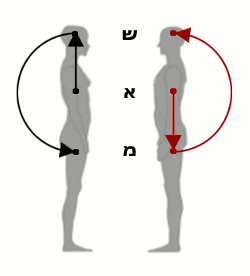
Arrows indicate the sequence of the letters in אמ"ש and אש"ם. What does this sequence symbolize? As stated above, Maharitz calls it the אמ"ש “forces.” Hence, here the issue can be either in the sequence of the “turning on” of forces not connected with each other (like traffic lights), or in movement of forces. “Sepher Yetzirah” himself (3:2) points to the correctness of the second understanding, calling the different sequences of the three letters אמ"ש “rings.” Yechezkel also points to the circular movement in his vision, repeating twice. “...for the spirit (Ruah) of the living creature was in the wheels” (Ezekiel 1:20, 21). Under Maharitz, we can consider this movement at different levels. In this paper, we'll limit ourselves by the Nefesh level (according to the classical kabbalistic system) or the energy level (according to the scheme, described in the chapter “The Complex approach of Kind David”).
Let's proceed to the next stage. We shall join the אמ"ש and אש"ם schemes.
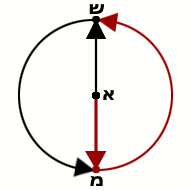
We see from the figure that the power contact, which began with א, has looped the energy of two beings in one circle, one energy entity. It remains to replace אמ"ש and אש"ם with איש and אשה — and then it becomes clear not only why the Torah in the second chapter speaks about the creation of man in the singular, but also the following, “Therefore shall a man (ish) leave his father and his mother, and shall cleave unto his wife (ishto11): and they shall be one flesh.” (Genesis 2:24). “And shall cleave” in Hebrew וידבק, from the noun דבקות (Dvekut), the word used to describe the highest degree of unity. “Shall be one flesh” is a literary translation. The original in Hebrew carries a much deeper sense, “shall be to the united flesh” (לבשר אחד). On the hand, the preposition “to” indicates directed movement (of energy, emotions, etc.) and on the other hand, makes it impossible to understand this phrase in a physical sense.
So, the given scheme describes the harmony between man and woman, and puts these relationships beyond the scope of biological connections between the two sexes (male and female).
What King Solomon did not know
Anyone knows that King Solomon was the wisest of men to have ever lived on earth. In the prime of his life he wrote the book “Mishle” (“Proverbs”), containing the following words. “There be three things which are too wonderful for me, yea, four which I know not: the way of an eagle in the air; the way of a serpent upon a rock; the way of a ship in the midst of the sea; and the way of a man (גבר from the word גבורה: “courage”) with a maid (עלמה)” (30:18–19). Indeed, even the wisest man cannot foresee the way of an eagle in the sky, nor the way in which a serpent crawls upon a rock, nor the exact path of a ship at sea. The fourth thing is surprising at first glance. It is clear that here there cannot be any question of the physical level. But if the energy contact of a man and woman can always be described as איש and אשה, then what could be unknown here to King Solomon? We can also find the answer to this question with the help of ”Sepher Yetzirah.”
“He made מ king over Water, bound a crown to it, and combined one with another (i.e. the letters). And with them sealed Earth in the universe, the Cold in the year, and the Belly in the human; the male with מא"ש, and the female with מש"א.” (3:8)
המליך אות מ"ם במים וקשר לו כתר וצרפן זה עם זה וחתם בהן ארץ בעולם וקור בשנה ובטן בנפש זכר במא"ש ונקבה במש"א
“He made ש king over Fire, bound a crown to it, and combined one with another. And with them sealed Heaven in the universe, the Hot in the year, and the Head in the human; the male with שמ"א, and the female with שא"ם.” (3:9)
המליך אות שי"ן באש וקשר לו כתר וצרפן זה עם זה וחתם בהן שמים בעולם וחום בשנה וראש בנפש זכר בשמ"א ונקבה בשא"ם
Let's represent what was written schematically. If we replace the letter מ with י or ה according to the what is said in “Kol Yehuda,” then the letter combinations themselves become meaningful words:
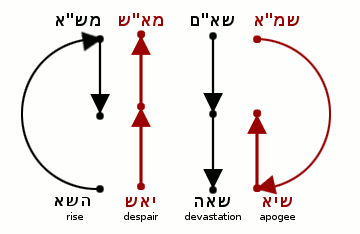
As we can see, the Torah describes the ideal state only, while ”Sepher Yetzirah” gives non-ideal options also. (It is interesting that the brief version of ”Sepher Yetzirah” gives only אמ"ש and אש"ם too.)
Now let's try to represent the combinations of all the “male” diagrams with all the “women” ones:
אמ"ש + אש"ם
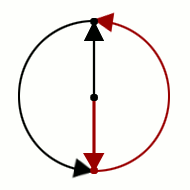
Description: there is an energy exchange; אדם = איש + אשה; everyone feels the sense of Shlemut (integrity); harmony.
מא"ש + מש"א
Description: there is no energy exchange; he feels the despair, she feels the rise, but there is no feeling of satisfaction.
שמ"א + שא"ם
Description: there is no energy exchange; she feels the devastation, he feels the climax, but not the harmony.
מא"ש + אש"ם
Description: the directions of the energy are same, so there is an exchange; he feels the despair, but she feels like a Woman.
שמ"א + אש"ם
Description: there is an exchange of energy, however not simultaneous, but sequential; each in turn “gets one's own back;” both feel dependence on each other; when he gives her a chance to feel herself like a woman, then he easily feels despair himself, but then at another time she lets him to feel at the top level.
שמ"א + מש"א
Description: “on a razor's edge” — every time the relations lead either to harmony or to conflict.
מא"ש + שא"ם
Description: he feels the despair, she feels the devastation at the end, with the conflict in the process; both are unhappy: “they make a pair.”
אמ"ש + מש"א
Description: there is an exchange of energy, but there is no harmony and easiness; everyone “stays himself;” the energy moves in an infinite circle, causing some feeling of tiredness (due to descend on the front line, reminding the movement on אש"ם).
אמ"ש + שא"ם
Description: there is an energy exchange, and he feels like man, but she feels the devastation.
”Sepher Yetzirah” says about the fact, that the real states of man stand behind permutations of the letters: “...and the circle rotates forward and backward, and this is the sign: there is no good higher than Oneg (ענג: ‘pleasure, delight’), and there is no evil lower than Nega (נגע: ‘wound, damage, misfortune’).” (2:4)
וחוזר הגלגל פנים ואחור וזהו סימן לדבר אין בטובה למעלה מעונג ועין ברעה למטה מנגע
As we see, both words ענג and נגע consist of the same letters, but “the circle rotates forward and backward.” In the same way “six rings” אמ"ש describe six directions of the energy in man: three in him and three in her.
Now the words of King Solomon, “I know not... the way of a man with a maid” becomes understandable to us. Indeed, the flow of energy is such a thing that is hidden from our eyes, and it is impossible to identify it based on a person's appearance. This problem stands not only before the King Solomon.
What does it depend on?
What can it depend on, according to which type of energy flows in a person?
1. On the harmony between parents.
Rabbi Yoel Schwartz writes in his book “Secrets of a Happy Marriage” (p. 9): [Page number may be incorrect: I don't know the page in the English translation, if it exists! — Daniel Alievsky] “Also Kabbalah teaches a very important thing, that each of the intimacies between a man and woman, even if a child was not conceived from it, still gives birth to spiritual forces that are a (specific) kind of soul.” [It could be incorrect: I didn't find this book in English! — Daniel Alievsky] First, let's consider a variant where intimacy was crowned by conceiving a child (a more detailed analysis of the rabbi Y. Schwartz's sentence will be given below). The rabbi's words can be understood in the following way. As physical intimacy joins a spermatozoon and an ovum and thus lays the foundation for development, so the accompanying emotional and energetic contact lays foundation of the energy profile of a future person. Are you familiar with the expression “fruit of love?” It means that a person, born in harmony (referring to the moment of conception and beyond), is a bearer of this harmony, thereby is exciting an intuitive sympathy among his surroundings. The Torah teaches that there are kinds of intimate relationships that can give rise to types of handicaps, which will not be blotted out from the descendants of many generations to come. I'll give only two examples: incest and illegitimate children (this subject can be studied more completely from the Torah). Incest is an intimate relationships between close relatives, forbidden by the Torah. The story of the two daughters of Lot, who became pregnant by their father can be an example of incest (and with pure intentions). The nations Amon and Moab came from them. An illegitimate child (mamzer) is someone born by a married woman from another man. This is what Torah commands Jews. “A bastard shall not enter into the congregation of the LORD; even to his tenth generation shall he not enter into the congregation of the LORD. Ammonite or Moabite shall not enter into the congregation of the LORD; even to their tenth generation shall they not enter into the congregation of the LORD for ever” (Deuteronomy 23:2–3). The sages taught (Talmud Yevamos, 76a) that the expression “enter into the congregation” means a permission to enter into a marriage with them. Of course, these people are not guilty that they were born like that, but even more their potential spouses are not guilty...
2. On the season of birth.
Really, much is laid at the moment of conception, but it's possible to talk about “a full-fledged human” only after the birth. The Talmud teaches these things by reviewing painful issues concerning life and death. until what moment in a difficult childbirth is it permissible to end a fetus' life in order to save the mother (Rashi on Sanhedrin 72b)? Should a delay be provided for the period of childbirth of a pregnant woman, condemned to death by a court decision (Arachin 1:4; Tosephta, ibid (1:4), the Babylonian Talmud at the same place, 7a; see also Nazir, 51a). In the discussed context, the words of the sages (especially Rashi, who believed we cannot yet talk about Nefesh before the head comes into the world) can be interpreted as follows. The fetus is like a part of the mother in the her womb. During this period, his relationship with the outside world on the physical, energetic and emotional level are carried out only through the mother. From the moment of birth, his relationship with the outside world becomes direct, which means from that moment a person becomes directly affected by external forces. We can recall here such seasons as Cold, Hot, and Temperate, and all that “Sepher Yetzirah” says in this regard.
3. On the initial thought at the moment of meeting.
Let's recall that, according to Maharitz, אמ"ש can work vertically. Now let's try to correlate this model with another model, used in the book “Nefesh HaChaim,” namely:
Sehel (שכל: intelligence) — Regesh (רגש: feelings, emotions) — Guf (גוף: body).
We come to the following correspondences:
ש — ראש (“rosh,” head) — שכל — intelligence, logic, calculation;
א — רויה (“ruah”) — רגש — emotional attraction;
מ — בטן (“beten,” belly) — גוף — physical (sexual) attraction.
The sequence of inner experiences of the person himself depends on a “letter,” from which the attraction to a partner begins, and the harmony of the following relationships depends on the mutual correspondence of the scenarios. Let me remind that there are only six scenarios (three for the male sex and three for the female) and their combinations. The reader can easily complete the details himself.
Note. Here it is useful to recall that Jewish tradition gives preference to an introduction with an assistance of a third person before an accidental encounter. Such an introduction supposes the possibility of preparation for the crucial meeting, which is absent when a meeting is by accident.
4. On the first intimacy.
Let's start the conversation with a seeming contradiction in the Tanakh. Intimate relationships are not considered as sin themselves, yet virgins (man and woman) stand as symbols of purity and chastity. To resolve this contradiction, let's suppose that the energy circulates in a circle before the first intimacy, like in Adam before the division into man and woman. A tendency to a certain flow of energy is already beginning to appear in the period between pubescence and the first intimacy under the influence of the listed factors, but it is still not final. It is the first intimacy that breaks the circle of energy and from that moment the person is no longer self-sufficient in terms of energy, and one of the types of energy movement, described in “Sepher Yetzirah,” is fixed in him/her. The Scriptures hints at this to us, speaking of the foremother Rivka, “...a virgin, neither had any man known her” (Genesis 24:16). Here is Rashi's commentary to this sentence. “‘A virgin’: at her maidenhood (ממקום בתולים); ‘neither had any man known her’: [she had no] unnatural relations (שלא כדרכה). Since the gentile maidens guard their maidenhood and are promiscuous in unnatural ways (ממקום אחר), Scripture therefore testifies about her that she was innocent of all this.” We can conclude from Rashi's words, that intimacy, even with preserving the hymen, changes the state of energy in the organism. A lot of factors affect a person at that moment: environment, energy of the partner, personal spirits, etc. And afterwards the person carries the given energy “impress“ for life. And after this it is very difficult for then to hope to find another partner to match them energy-wise.
Probably the knowledge of these things can explain the fact, that the forefather Avraham sent a caravan for Rivka even despite the fact that Rivka's family worshiped idols, and did not take a bride for his son from the daughters of Lot, a nephew of Avraham, who was one of the few monotheists at that time. Hence, it is easier to correct an outlook on the world than it is to correct the flow of energy.
I have listed four answers to the formulated question in this chapter. Which one is more important, and which is less? I do not know, but I think that it is more important to know the answer to the following question.
Is it possible to change the nature of my energy?
“Sepher Yetzirah,” as we saw above, describes the laws of the universe as an objective reality, but does not discuss the ability to change anything. Another source, the midrash about the dispute of Avraham and Nimrod (B'reshith Rabba, 38), tells about this ability. It is no accident that both “Sepher Yetzirah” and this midrash are associated with Avraham's name, for they seem to supplement each other.
Here is a summary of the midrash. Nimrod commands Avraham to worship the fire. Avraham replied, “Does not the water put out the fire?” Nimrod offers to worship the water, on which Avraham notes, “The cloud carries the water.” Nimrod agrees and offers to worship the cloud. Avraham continues, “The wind (Ruah) scatters the clouds.” And on an offer to worship the wind, he objects, “The human withstands the wind.” Nimrod does not stand up and orders to throw Avraham into the fire, but Avraham goes out of the fiery furnace alive and unharmed.
Before we proceed to the analysis of the midrash, I remind you that as far back as Rambam, he warned against a literal understanding of Haggadah (Midrash) on one side and a neglectful relation to it on the other (see the preface to “Pereq Helek”).
Now let's try to ponder the meaning of our midrash. What does the offering to worship the fire mean? To fall on one's knees in front of a candle or to bow to a gas burner? It is clear that here it is speaking about recognizing the power of the Fire Element, that is, about the metaphysical root of the physical fire. Similarly, all other terms used in the dispute by forefather Avraham, should be understood not as physical forces of nature, but as their metaphysical roots, and they should be written with a capital letter: Fire, Water, Cloud, Ruah (Wind), Human. Do it seem strange to you that all three, — Fire, Water, Ruah, — elements of the universe are present here (according to “Sepher Yetzirah”)? I draw your attention also to another oddity, which emphasizes the absurdity of a literal understanding of the midrash. Is the human body really the most successful thing to withstand the wind? Is a tree or a brick house not better in this regard? What does the cloud indicate? I do not know. Possibly, it corresponds to the eastern Tree Element, which also has an ability to carry water. And it's possible that the cloud is only a literary device used to make the story concise in its simple perception. (We should not forget that an external form of this kind of Jewish wisdom is legend, proverb, fairy tale.)
We see that both the worldview of Nimrod and the worldview of Avraham are based on the same foundation of teaching about the basic elements of the universe. Their positions differ in only one way and that is in the question of the abilities of the human. Can a human influence the metaphysical processes? Avraham's answer is yes! This idea is not obvious for Nimrod. In his opinion, it is logical for Avraham to confirm his rightness with an experiment, because if the idea is true, it should work in the same way both on the metaphysical and on the physical level (remember the Maharitz's words that אמ"ש operates on every level).
Avraham's victory in the dispute with Nimrod gives us a hope that a human can change his energy nature. By the way, this midrash has a supplement. “After Avraham came from the furnace unharmed, Haran (his brother) entered into the fire and was burned up there.” Perhaps this end hints at the fact that only faith (in the human's ability to change his energy nature) is not enough, but that he also needs to possess the knowledge of how to do this.
Each intimacy gives birth to a soul
We are returning to the study of Rabbi Yoel Schwartz's book “Secrets of a Happy Marriage.” “Kabbalah also teaches a very important thing, that each intimacy between a man and a woman, even if a child was not conceived in it, still gives birth to spiritual forces, which are a (certain) kind of souls. And so the intimacy was not in vain even for those who were not awarded by the birth of a child. Based on this, (the sages) explained the following, as stated in the Torah. Avraham is ‘a father of many nations’ (Genesis 17:5). And he is not only their spiritual father (as he has become the father of mankind in matters of faith in God because he propagated it around the world), but he is still, in a sense, the actual father of those heirs who take giyur, and (it's said) about them that everyone, taking giyur, adds a spiritual level to his soul. This level is the result of intimacy between Avraham and Sarah, which they carried for dozens of years before Sarah became pregnant and gave birth to Yitzchak.” Each intimacy gives birth to independent immaterial essence, which, in other words, is called soul. At first glance, the statement above contradicts the words of the sages that three are involved in a birth: a father, a mother and God, who gives the soul (treatise “Kidushin” 30b). As a result, it is unclear what the soul is. Whether it is God's gift or the product of parents' intimacy? This contradiction is resolved simply. We are talking about different levels of the soul. The soul, a the gift of God, is a bearer of such qualities as the desire to do good, aspiration to justice, etc. The soul from the parents is an emotional-energy formation. The parents' soul, together with the body, forms the vessel to which the Divine soul descends. It sometimes happens that a very pure and lofty Divine soul descends into a harmonious parents' soul (for example, King Solomon), and sometimes into a disharmonious parents' soul (for example, King David). The sages taught this (Vayikra Rabba, 38). “Rabbi Aha interpreted: David said this in front of the Lord: ‘Lord of the Universe, Yishai did not intend to create me, he only satisfied his passion. And as soon as the passion had been satisfied, the father turned his face to one side, and the mother — to another. And You have collected every drop.’ And about this David said, ‘When my father and my mother forsake me, then the LORD will take me up.’ (Psalm 27:10).” Perhaps the sages wanted to explain to us with this Midrash, how the same man has become the author of such lofty book as “Tehilim” (“Psalms”) and yet had sinned with another man's wife at the same time. We can also understand from the words of Rabbi Yoel, that in these cases, when conception has not occurred, a bundle of energy (the parents' soul) is still formed in space.
We are continuing to quote Rabbi Yoel. “We can teach in the opposite direction in the same manner, how difficult are (the consequences) of an intimacy, prohibited by the Law of God, and also the emission of semen in vain. They create negative spiritual forces in the world that cause various harm, especially to whomever generated those forces. Often a person suffers from these forces, even without understanding why (various bad) things happen to him. We are talking about this world. But the main harm is inflicted on a person by these forces after death, when they (forces-souls) chase his soul and cause it suffering, which is considered a part of the suffering of Hell” (ibid.). [This could be incorrect: I didn't find this book in English! — Daniel Alievsky] We can conclude from reading this, that an intimacy not only with a real partner, but also with a virtual one (as in the case of spilling semen in vain while warming oneself with fantasies of a partner) gives birth to an independent emotional-energy essence, which can be called a soul of the lowest order. These souls do not just come into the world, but are able to return good for good or evil for evil to their parents.
All this leads us to think seriously about the importance of purity of thoughts during intimacy. For this reason, we'll give a passage from the Rabbi Mordechai Eliyahu's book “The Road to Purity.”
“Nine cases of prohibited intimacy between spouses are listed in the Talmud (Nedarim 20b), in which children with vicious tendencies can be conceived. These include a sexual relationship:
- Against the wishes of the wife.
- In a case when the husband hates his wife.
- In a case when the husband or the wife are separated from community.
- In a case when the husband, during sexual intercourse with his wife, is thinking that he carries intimacy with another woman (‘substitution’).
- In a case when the wife does not want to stay married.
- In a state of alcohol intoxication.
- In a case when the husband is going to divorce his wife.
- In a case when the husband or the wife, during sexual intercourse, are thinking about other partners also (‘mixing’).
- In a case when the wife is openly (in words) expressing the requirement of sexual intimacy.
According to the views of some authorities, this group also includes:
- In a case when the wife is sleeping during sexual intercourse.
They say that children, born as a result of such prohibited sexual relations, are like “mamzers” (born of adultery). Although, of course, they are not “mamzers.” And while the destiny of such children, of course, is not predetermined (it is not certain that they will become villains or criminals), yet they will have strong vicious tendencies, and a righteous life will be difficult for them.” [This could be incorrect: I didn't find this book in English for free! — Daniel Alievsky]
Intimacy for conception and intimacy for strengthening the family
The first commandment of the Torah, given to all humanity, is, “Be fruitful, and multiply, and replenish the earth...” (Genesis 1:28). In other words, there is a commandment of God to bring children into the world. As the minimum, this commandment is considered to be fulfilled when a person gives birth to at least one boy and one girl. The maximum is not specified. I hope the reader already knows the methods for fulfilling this commandment. (Even those who will think of the artificial insemination will agree that it is not comparable to the natural way in quantitative terms.) Not only people, but also animals know how to “be fruitful and multiply.” For them and others, it is associated with having delight, which acts as such a powerful stimulus that it becomes an end in itself for many. (Note that, according to the Written and Oral Torah, sexual delight is second place in the force of sensations only after the delight felt by a man upon receiving a prophecy. Idolatry was an attempt to artificially get such delight. More information can be found in the book “Torat ha-Sehel.”) So, for animals the sexual delight is the highest of the available pleasures, and the continuation of a species in nature would cease without it (see the Talmud story about withdrawal of Yetser ha-Min from the world (“Avodah Zarah” treatise)). No one registered yet that animals are driven by recognition of duty to bring a living soul into the world. As for the human, he is able to choose for himself very different models of behaviour in a given situation, and an ability to behave like an animal has always preserved him. The Torah, seeking to develop pure and lofty feelings in a person, however not only doesn't prohibit the intimacy, but, if it is carried out with the aim of conceiving a child, considers it fulfilling the will of God (mitzvah). According to the Torah, intimacy is not a sin, and getting delight from it also is not a sin.
On the other hand, Jewish law warns, “The sperm is the energy of the body and the light of the eyes. When too much is ejected, the body is destroyed and his life is lost. Any one who is addicted to having sex, old age comes upon him. His power fades, his eyes darken... Many other troubles apart from these come upon him. The wisest of the doctors said, One out of a thousand die out of all ill people, and that a thousand is from too much sex. Therefore a person should be careful.” (“Kitzur Shulchan Aruch,” 150:17).
Maybe only intimacy with the purpose conception is justified, but is intimacy of other reasons prohibited? No. An example of this is intimacy with the pregnant wife. “Our sages said that during the first three months intercourse is hard for the woman and hard for the fetus, that the middle is hard for the woman and good for the fetus, and that the last (3 months) is good for the woman and good for the fetus, for because of this the child comes out white and quickly” (“The Road to Purity,” Part 3, Ch. 16; “Kitzur Shulchan Aruch,” 150:9). This intimacy is no longer needed for conception, so what is it for? Rabbi Mordechai Eliyahu (“The Road to Purity,” ibid.) answers: “Thus, although the wife is pregnant, the husband fulfills the commandment of sexual intimacy.” [This could be incorrect: I didn't find this book in English for free! — Daniel Alievsky] The Torah separates the regular marital intimacy as an independent commandment, not always tied to the commandment to be fruitful and multiply. “...Her food, her raiment, and her duty of marriage, shall he not diminish” (Exodus 21:10). Rabbi Mordechai Eliyahu makes this comment. “When a man wants to advance in godly behaviour, he must understand that in so doing he must not abandon the actual law of the Torah and Sages even one iota, both in regard to himself and in regard to his relationship with his wife. And so, those who refuse to fulfill the commandments of the consummation of the marriage, specified in the Torah, from their ‘godly considerations’, will be responsible for it” (“The Road to Purity,” Part 3, Ch. 19). [This could be incorrect: I didn't find this book in English for free! — Daniel Alievsky] And also, “If a husband feels that his wife is trying to please him and is dressing up to draw his attention to herself, he must enter into intimacy with her” (ibid.). [This could be incorrect: I didn't find this book in English for free! — Daniel Alievsky] The reverse situation is also considered in Jewish law. “If a man sees, that his own sexual desires prevail over him, and fears, that he will think about other women or that spilling his sperm in vain will occur, he can enter into intimacy with his wife.” In this case, the wife needs to go towards meeting her husband this time. An example of this is the story from the Talmud (Ketubot, 65a) about that the widow Abaey who came to Rava's court. Rava felt attracted to her and, to cope with himself, ran home (in the middle of the day) and asked his wife (a daughter of Rabbi Hisdy) to enter into intimacy with him.
Summing up:
- According to the Torah law, intimacy to conceive a child (which also strengthens the family) and intimacy for strengthening the family is recommended.
- The main reason for restrictions, recommended by the sages, in the permitted (or rather, commanded by God) intimacy is the loss of sperm by the man and the resulting in the loss of vitality.
The proposed solution is intimacy without the emission of sperm in the cases when the intimacy is carried out without the purpose of conceiving a child.
It is interesting that the word שכב (“[he] lay”) occurs in the Tanakh more than two hundred times. Of those two hundred time it is used in the sexual sense less than fifty, and only in four cases it is said, “lay with the emission of seed.” Here are these places. “The woman also with whom man shall lie with seed of copulation, they shall both bathe themselves in water, and be unclean until the even” (Leviticus 15:18). “Moreover thou shalt not lie carnally with thy neighbour's wife, to defile thyself with her” (Leviticus 18:20). “And whosoever lieth carnally with a woman, that is a bondmaid, betrothed to an husband, and not at all redeemed, nor freedom given her; she shall be scourged; they shall not be put to death, because she was not free” (Leviticus 19:20). “And a man lie with her carnally, and it be hid from the eyes of her husband, and be kept close, and she be defiled, and there be no witness against her, neither she be taken with the manner...” (Numbers 5:13). In other cases, when the Scripture uses the word “lay,” nothing is mentioned about the emission of seed. Some may object that here we must use the logical principle of “equal cut” from the Baraita of Rabbi Ishmael, and that in addition to the cases where it's stated that he lay with the emission of seed, also the cases when it's simply said “lay” (but the emission of seed is not mentioned), the emission of seed it also meant. For example, in the story of David and Bathsheva (2 Samuel 11:4) Scripture does not speak directly about the emission of seed, but then the text speaks about the pregnancy. I answer with a question. For what reason would this logical principle apply to only 50 cases not to all 200? As not all lying implies the emission of seed, so not every intimacy must necessarily imply the emission of seed. Perhaps another logical principle is more applicable here, “how much more.” Then the conclusion can sound like this. If intimacy without emission of seed is prohibited by the Torah, all the more it is prohibited with emission of seed. And the four cases mentioned above carry some additional information that requires more careful study.
Tikkun ha-Berit for married ones
Let me give some practical tips to help a man not to emit the seed during the intimacy to strengthen the family:
- stop when you feel an erection approaching;
- only go halfway out (to avoid pressure on the pubic bone);
- squeeze the meatus (the end of the urethra found at the end of the penis) as much as possible and pull the energy through the loin along the spine upward to the crown of the head;
- if this fails to appease the wave of excitement, you should press with three fingers (forefinger, middle and ring) at the place where the spermaduct connects to the urethra, by pushing between the scrotum and the anus — either until the complete cessation of the “pulse” or until regaining control of yourself.
In any case, you should continue to stay inside so that even if a drop of sperm were to leak, it would come into the vagina and would not be considered emitted in vain.
Advice for maintaining and strengthening the male power
1. In the Tanakh the representatives of the male are described as “urinating against the wall” in six places (1 Samuel 25:22, 34; 1 Kings 14:10, 16:11, 21:21; 2 Kings 9:8). Here is a hint that the jet should be strong. For this reason, it is recommended:
a) to urinate in the standing position only;
b) to launch the jet as strong as possible;
c) for more loads, to urinate while standing on the toes.
This will make it possible to strengthen and improve the entire genitourinary system.
2. It is useful to make abrupt stops during urination, strongly tightening the urethral sphincter. You can repeat this several times during one visit to the toilet. The exercise will help to strengthen the muscle, which will be useful during intimacy.
WITH GOD'S HELP, TIKKUN HA-BERIT IS FINISHED!
Applications
Application 1. Women's commandments
We are living now in an epoch of post-feminism. Feminism is a movement for women's equal rights with men, which crept over all the civilized world in the XIX–XX centuries. It has forced the reconsideration of the role of women in society and family. The merits of this movement are very large. But, of course, there were local excesses. So, besides female members of the Government and women-astronauts, also female asphalt layers, women-weightlifters, etc. began appearing. Incidentally, trousers for women in Europe and America have come out just to erase the distinction between man and woman, not because “it is convenient.”
It is now obvious to many that the Divine Spark of feminism is in the fact that a woman has become able to realize her creative, business and other abilities, and that she is appreciated by men at her true value, but does not try to become similar to them. The men and the women have different functions in the world, and because of this they have different duties. Thus, “according a general principle (of the Jewish law), women are exempt from the positive commandments, the fulfillment of which is connected with a concrete time” (the Siddur “Gates of Prayer” by Machanaim, Introduction). Women are exempt from the commandments to wear tefillin, to wear tzitzit at the edges of clothing, to sleep in the sukkah, and many others.
It is interesting that the commandment to be fruitful and multiply, also, “is no concern” of women. I see the astonishment on your face and shall quote Rambam to strengthen the effect. “Women are exempt from this mitzvah, as our Sages said explicitly (Talmud, Yevamos, 65b): ‘Men have the obligation to be fruitful and multiply, not women’” (Rambam, Book of Commandments, commandment 212). Do not think that men are able to multiply without women ☺.
The Talmud explains that a woman has a physical necessity to “give life,” so it's not necessary to command her to do this. It is no accident that it is not Adam ha-Rishon, but just his wife that takes the name Chava, because she was the mother of all living (Genesis 3:20). Listen, how lofty it sounds, “because she was the mother...”
Below is what “Midrash Tanhuma” says about Noah chapter: “Thus have our masters taught us: Women die during childbirth for failure to observe three duties decreed in the Torah. These are: The duty with regard to menstruation (Niddah); the duty of the levy of dough (Challah); and the duty of lighting the Shabbath lights.” [This quote is from Google Books — Daniel Alievsky] I recall that the midrash is a figurative understanding of the words of the Torah. Midrash is a virtual model. You should represent it and should not understand it literally. Then how should we understand, “women die during childbirth,” and what are these three commandments saying? She “dies” for everyone except the child. The child becomes the main, and for many women the only, value. It's so natural. Is it really bad that a woman commits herself to her children? But there is a counter-question of why do the sages use the word “die” in this case? And what does not allow someone to “die?” Fulfillment of the so-called “women's commandments.” Niddah (laws of purity of the intimate relations) is a symbol of the wife's duty to her husband. Challah (symbolic separating of a piece of dough; at the time of the Temple, this bread was not separated symbolically and was given to Kohanim) is a symbol of a woman's duties to society. And finally, the lighting of Shabbath candles is a symbol of her duties before God. Rabbi Yisrael Meir Lau writes the following in the book “Practical Judaism.” “The abbreviation of their titles (hadlakat neroth, challah, niddah) is the word HaCHeN (charm, sympathy).” [This could be incorrect: I didn't find this book in English for free! — Daniel Alievsky] I can only suggest to all women, “Be charming!”
Application 2. Ruah concept
One of the fundamental concepts in the teachings of the East is that which is called “Tzi” in China, “Chi” in Vietnam, “Ki” in Japan (depending on pronunciation). What is meant by this word?
“Ki is the world-forming energy which also lies at the core of each human being, waiting to be realized and actualized... The original idea of ki developed as a metaphysical principle in a number of Chinese schools of thought. Ki was, for example, the essential principle of harmony, and it was the source of creativity expressed in the form of yin and yang (Lao-tzu), the vital fullness of life (Huai-nan-tzu), the courage arising from moral rectitude (Mencius), the divine force that penetrates all things (Kuan-tzu). As a term, it was never clearly defined. Sometimes it was equated to empty space (the void) or nothingness (Lao-tzu), at other times to the formative energy emerging out of chaos (Chuang-tzu). It was regarded by some philosophers as a dualistic principle that structures the universe.” (Kisshōmaru Ueshiba, the book “The Spirit of Aikido”).
However, representatives of eastern teachings cannot answer the question about the origin of the “Ki” doctrine. Kisshōmaru Ueshiba expresses the generally accepted opinion that, “When ancient people used their intellectual and imaginative powers to discern the workings of the universe, the source of all life, they came up with the concept of ki.” And we have found no more details about those “ancient people.”
In recent years, many people say that all teachings come from the one Divine Source.
For Jews, the Divine Truth manifests itself in the form of the Torah. And the thing, called “Ki” at the East, is called by the word “Ruah” in the Torah.
The word “Ruah” has the following meanings in the Tanakh (taken from the Tanakh Concordance edited by A. Even-Shoshan):
a) air movement;
b) the soul of all living things, the soul;
c) feeling, inspiration;
d) vanity, emptiness, nothing;
e) side.
The word “Ki,” that widened the vocabulary of a civilized human, is multi-aspect too: “Since we lack a precise equivalent, the translation will depend on the emphasis we place on the diverse dimensions of Ki. That is, we can stress the spiritual aspect (spirit, soul, ethos), the affective aspect (sense, intuition, feeling), or the psycho-physiological aspect (breathing, breath).” (Kisshōmaru Ueshiba, “The Spirit of Aikido”).
It is also interesting to note that both “Ruah” and “Ki” have no personality nature, in contrast to the Christian understanding of the word “Spirit.”
What role is given to a person in all this teaching?
The Japanese see two aspects here:
1) Achieving personal harmony with the world via “Ki.”
Thus, the founder of Aikido, Morihei Ueshiba, speaks about this in the following verse.
Standing amidst heaven and earth
Connected to all things with ki,
My mind is set
On the path of echoing all things.
2) Transmission of “Ki” through yourself further, with the purpose to harmonize another person or situation (Reiki).
This issue is elucidated in Judaism in the following way. HaRan (Rabbi Nissim ben Reuven), while analyzing a verse of the Torah (Deuteronomy 8:18), writes, “‘But thou shalt remember the LORD thy God: for it is he that giveth thee power to get wealth.’ It is not said, ‘But thou shalt remember the LORD thy God: for it is he that giveth thee wealth.’ And if so, the power given to man is the cause and means to achieve wealth, but it is not so. Therefore it is said, “Thou have gotten this might with thine forces, remember the Giver of the force. Blessed be He.’” [This could be incorrect: I didn't find HaRan's texts in English! — Daniel Alievsky] (It is clear that the word “wealth” should be understood in a wide sense.)
You see that the Jewish approach differs from the eastern one, according to which the source of power is not personified. As Zen monk Takuan writes (1573–1645), “Penetrating to a place where heaven and earth have not yet divided, where Yin and Yang have not yet arrived, I quickly and necessarily gain effect.” I.e. the only personality in this process is a man. But Judaism insists that there is another person “in this game” — God! And it means that He gives “power” to man, but does not serve him as only “raw materials base.”
In addition, if we are dealing with a Person and if we are depending on Him, then we are interested in a dialogue with Him. And the only form of dialogue with God is the observance of His commands (commandments).
It is also necessary to note that God is not only the source of “Ruah–Ki,” but also the source of information about “Ruah–Ki” (exactly God, not people, as stated in one of the quotes above). We do not know for sure when God gave people this knowledge and how it was spread on Earth, but maybe the following will help us to settle this matter.
It is said in the Torah that the forefather Avraham, before his death, sent all his children except Yitzchak (Ishmael is not mentioned in this passage) to the East with the gifts. The Midrash says that the gifts in question are the teachings of the East. Perhaps here is a connection to the theme, touched on above.
- Midrash is a figurative model, based on which man can understand one of the aspects of the world structure. In other words, Midrash is a divine idea, shaped in the form of a fairy tale. “Midrash Rabba” was written by sages, the authors of the Talmud, in the IV century.
- Ejaculation is necessary for family relationships when the goal is to conceive a child. A man can get sexual pleasure without ejaculation (this will be discussed in the second half of the book).
- Quoting someone's words, I don't try to give some estimates to the author in any way, but only use someone's ability to formulate an idea, which dominated many people. And it does not even matter what the author thought, expressing a particular idea. Being born by someone, an idea lives by an independent life.
- Rubaiyat of Omar Khayyam are translated by Vlanes from the Russian book «From Omar Khayyam to Ecclesiastes» by German Plisetski (Герман Плисецкий, От Омара Хайама до Экклезиаста, “Фортуна Лимитед,” Москва, 2001).
- To comprehend the scale of the tragedy, recall that in the story with the golden calf “only”
3,000 people perished (Exodus 32:28). - The list of descendants starts with the word “Toldot” usually, and at this point the Torah says this about Noah.
- Seventy faces of Torah is a symbol of all true knowledge about the world and about man compressed by God into a relatively short text, which is the Written Torah. This knowledge can be obtained by analyzing the text of the Torah in different ways. Thus, it is emphasized that the Divine reality, embodied in the world or reflected in the Torah, has only “seventy faces” but not somewhat as it is when “opinions differ.”
- Besides the word “Kavod,” Tanakh also uses a number of terms related to energy, such as the Ruah, Oz, Koah, Hail, Tuma, and Tahora.
- Over the centuries, Jewish sages struggled with the literal understanding, among the people, of anthropomorphisms used in the Torah in relation to God. Now no one interprets such expressions as “Hand of God” and “Eye of God” literally. The problem, acute in our time, is interpretation of some terms of the Torah in form of abstract concepts. This delusion is not less dangerous than the previous one, because it makes the Torah, in people's eyes, from the description of the Divine order of the world into an abstract system, God forbid! It is necessary to understand that such words as Ruah, Shekhinah, Kavod, Tuma, Tahora and others are terms that indicate objectively existing phenomena.
- This means the unutterable Four-letter Name, called the Tetragrammaton.
- “Ishto” is the same thing as “isha shelo,” that is, “his wife.”
Tishri 5770